Tecpa (MH486v)
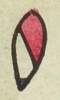
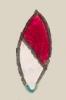
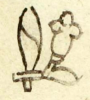
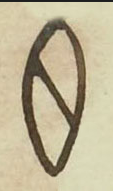
This black-line drawing of the simplex glyph for the personal name Tecpa (here, attested as male) shows an upright flint knife (tecpatl) in a frontal view. It has a diagonal line, leaning left, and cutting across the knife at about the middle. Sometimes the knife is half red (bloodied?) and half white. The convention is for the top half to be red.
Stephanie Wood
The flint knife was both a day sign and a year sign in the calendars, which testifies to its religious significance. Here, as a personal name, it would have been drawn from the tonalpohualli (day count). Originally, a name such as this would have had a companion number from 1 to 13. But these numbers were dropping away out of some natural evolution (simplification? diminishing memory of the formula? or as a response to pressure from clergy who were trying to suppress the use of the tonalpohualli). Here, the sign it is very basic, but sometimes it is decorated and even anthropomorphized. The word for obsidian blade (itztli) overlaps with the tecpatl.
The tonalpohualli, being used for "prognostication and divination, had no parallel and contravened Christian dogma so its use was disavowed and prohibited." [See Rubén G. Mendoza, Ritual Human Sacrifice in Mesoamerica (2024), 439.] Nevertheless, calendrics were an important part of Nahuas' religious views of the cosmos, and this practice survived a long time under colonialism, even if in modified form.
Stephanie Wood
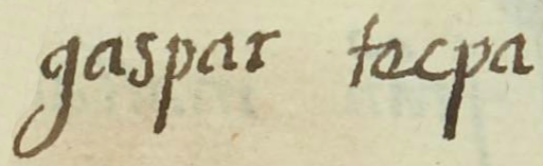
gaspar tecpa
Gaspar Tecpa
Stephanie Wood
1560
Stephanie Wood
knives, cuchillos, navajas, calendars, calendarios, xiuhpohualli, año, turquesa, xihuitl
tecpa(tl), flint knife, https://nahuatl.wired-humanities.org/content/tecpatl
Pedernal
Matrícula de Huexotzinco, folio 486r, World Digital Library, https://www.loc.gov/resource/gdcwdl.wdl_15282/?sp=52&st=image.
This manuscript is hosted by the Library of Congress and the World Digital Library; used here with the Creative Commons, “Attribution-NonCommercial-ShareAlike 3.0 License” (CC-BY-NC-SAq 3.0).