Teocaltitlan (Verg27v)
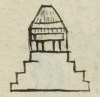
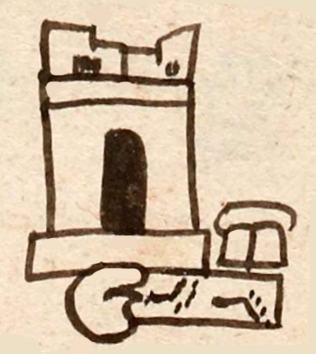
This compound Nahuatl hieroglyph is a black-line drawing of the place name Teocaltitlan (“Near the Temple”). The drawing of the building would be enough to make the town name clear, but various phonetic elements are added to ensure the reading. The chin and lips (tentli) provide the Te- start to the name. The footprinted road (otli) adds the -o- to Te- for Teo-. The two front teeth (tlantli) provide for the suffix (-tlan). The architecture of the teocalli is interesting for what appear to be ramparts on the roof, and the dark, arched entryway shows some colonial artistic influence. Another Teocaltitlan, from folio 30 recto, has a rectangular opening to the temple. Otherwise, that compound is much like this one.
Stephanie Wood
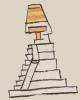
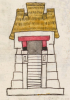
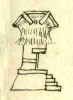
Nahua hieroglyphic representations of temples typically have stepped pyramids with a small structure on top, often with a thatched roof, as a Quick Search in this collection for the term teocalli will show.
Stephanie Wood
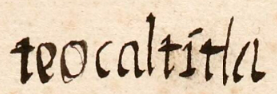
teocaltitla
Teocaltitlan
Stephanie Wood
1539
Jeff Haskett-Wood
nombres de lugares, templos, iglesias, puerta arqueada, fonetismo
teocal(li), a temple, https://nahuatl.wired-humanities.org/content/teocalli
Cerca del Templo (nombre del pueblo)
Stephanie Wood
Available at Codex Vergara, folio 27v, https://gallica.bnf.fr/ark:/12148/btv1b84528032/f62.item.zoom, accessed 22 February 2026. The Vergara is associated with Tepetlaoztoc, in the larger region of Tetzcoco, c. 1539–1543.
“Source gallica.bnf.fr / BnF.” We would also appreciate a citation to the Visual Lexicon of Aztec Hieroglyphs, https://aztecglyphs.wired-humanities.org/.
Image Rights: The non-commercial reuse of images from the Bibliothèque nationale de France is free as long as the user is in compliance with the legislation in force and provides the citation: “Source gallica.bnf.fr / Bibliothèque nationale de France” or “Source gallica.bnf.fr / BnF.” We would also appreciate a citation to the Visual Lexicon of Aztec Hieroglyphs, https://aztecglyphs.wired-humanities.org/