teopan (Chav1)
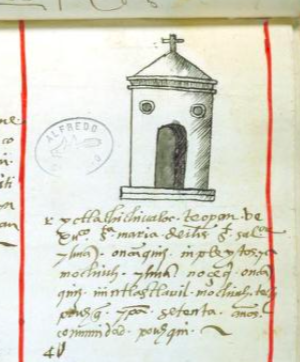
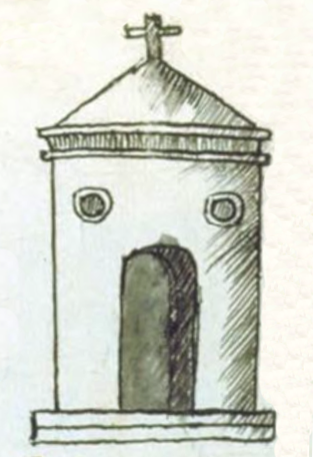
This black-line drawing of the simplex glyph for the noun teopan or teopantli (“church”) is mentioned in the Nahuatl text. The glyph shows a Christian church that was built in honor of the Virgin Mary in Huexotzinco (Huejotzingo, today). The building has a domed roof with a cross on top. It appears to be round, with an arched doorway, two tiny windows, and a triple-layered foundation. Shading on the right side creates three-dimensionality, showing European stylistic influence.
Stephanie Wood
Like the tecpan (governing palace), which typically lacks an absolutive, the teopantli was often just called teopan.
Juan José Batalla points out how the curving arched doorway, sometimes called tecololli in Nahuatl (and notes how perhaps tolcalli would be more appropriate), is a European architectural introduction. See: "Análisis de elementos gráficos de contenido occidental en los glifos de los códices coloniales del Centro de México: el caso de los antropónimos nahuas," in El arte de escribir. El Centro de México: del Posclásico al siglo XVII, eds. Juan José Batalla Rosado and Miguel Ángel Ruz Barrio (Zinacantepec, Estado de México: El Colegio Mexiquense, A. C., 2018), 84.]
Stephanie Wood
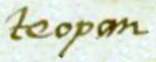
teopan
1578
Stephanie Wood
iglesias, capillas, arquitectura religiosa
teopantli, church, https://nahuatl.wired-humanities.org/content/teopantli
la iglesia
Stephanie Wood
The Codex Chavero of Huexotzinco (or Códice Chavero de Huexotzinco), https://www.loc.gov/resource/gdcwdl.wdl_03246_001/?sp=1
The Codex Chavero of Huexotzinco (or Códice Chavero de Huexotzinco) is held by the Instituto Nacional de Antropología e Historia, México. It is published online by the World Digital Library and the Library of Congress, which is “unaware of any copyright or other restrictions in the World Digital Library Collection.”