Tepetlaoztoc (TK204v)
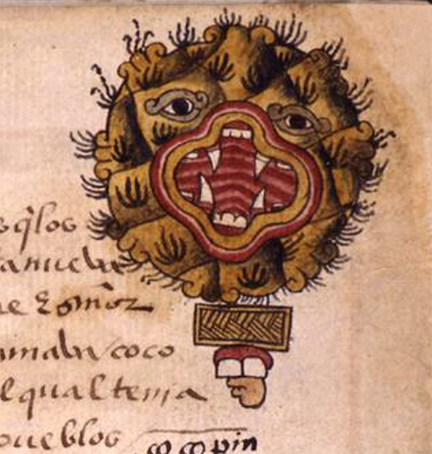
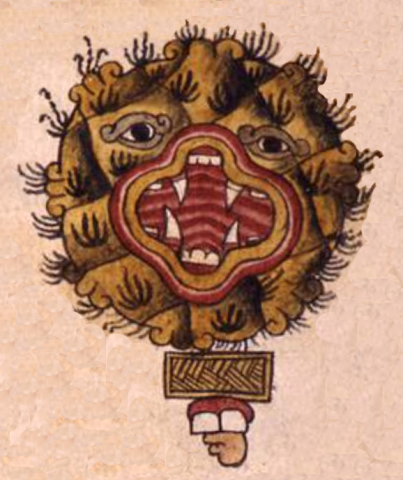
This compound Nahuatl hieroglyph stands for the place name Tepetlaoztoc (today spelled Tepetlaoxtoc), which translates roughly as “In the Volcanic Rock Cave”). Tepetlaoztoc is an altepetl in the Tetzcoco (spelled Texcoco today) area. The compound glyph has four elements. Beginning at the bottom and reading upward, the first element represents human lips (tentli), which provides the phonetic indicator for the start of the name Te-. Next are two front teeth (tlantli), which provide the phonetic indicator for the -tla- syllable, which complements the second part of the woven mat (petlatl). The petlatl provides the disyllabogram (-petla-) that has nothing to do with the meaning of the place name, but rather contributes phonetically to the semantic root of tepetlatl (volcanic rock). At the top of the string of elements is a large sign for cave (oztotl), which plays a significant semantic role in the meaning of the place name. This cave has iconography for a mountainous exterior, but the opening to the cave is the mouth of what might be called an earth monster. This is a frontal view that reveals a mouth with a red interior and ridges on the roof of the mouth and white teeth that include some long fangs. The mouth is outlined with red and yellow. The eyes are open. Finally, the locative suffix (-c) is not shown visually.
Stephanie Wood
This compound glyph is not glossed, but the manuscript is named for this altepetl, and the elements that comprise the compound all support the reading. Below are some links to a variety of place names that have cave (oztotl) themes. The Mesoamerican concept of a cave entrance as an animal’s mouth was (and may still be) widespread. See Karl Taube’s article in Atlas Obscura (19 June 2023) about the Olmec example of this phenomenon that was recently returned to Mexico.
Side Note: The folio numbers are not always clear in the copy published online by the British Museum. Marc Thouvenot gives this page the number K02_B in his TLACHIA digital collection, https://tlachia.iib.unam.mx/tepetlaoztoc/K02_B.
Stephanie Wood
c. 1556
Jeff Haskett-Wood
cuevas, piedras, monstruo, monstruos, petate, tepetate, dientes, boca, labios, topónimo, topónimos, pueblo, pueblos, towns
ozto(tl), cave, https://nahuatl.wired-humanities.org/content/oztotl
tepetla(tl), volcanic stone, https://nahuatl.wired-humanities.org/content/tepetlatl
ten(tli), lips, https://nahuatl.wired-humanities.org/content/tentli
tlan(tli), teeth, https://nahuatl.wired-humanities.org/content/tlantli
petla(tl), woven mat, https://nahuatl.wired-humanities.org/content/petlatl
-c, locative suffix, in, https://nahuatl.wired-humanities.org/content/c
Dentro de la Cueva de Tepetate
Stephanie Wood
The Codex Kingsborough, also known as the Códice de Tepetlaoztoc, and the Memorial de los indios de Tepetlaoztoc, is not on display. It was transferred from the British Library and is now held by the British Museum. It is shared on line at: https://www.britishmuseum.org/collection/object/E_Am2006-Drg-13964
©The Trustees of the British Museum. Shared under a Creative Commons Attribution-Non-Commercial-ShareAlike 4.0 International (CC BY-NC-SA 4.0) license. Please also cite the <em>Visual Lexicon of Aztec Hieroglyphsem>, ed. Stephanie Wood (Eugene, Ore.: Wired Humanities Projects, 2020-present) and this URL.