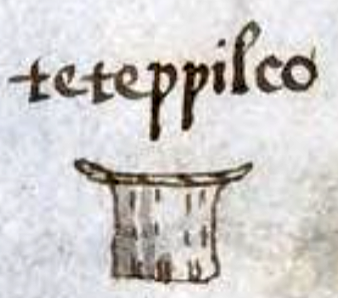
Tetepilco (Osu11r)
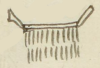
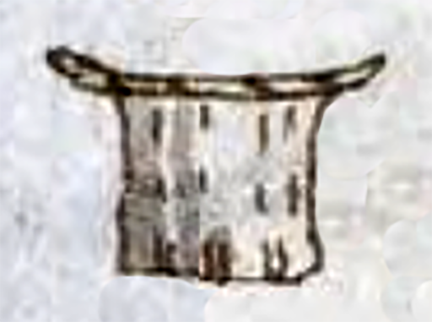
This black and white line drawing of the simplex Nahuatl hieroglyph represents the place name Tetepilco (perhaps, “At the Vulvas”). It appears to be a ritual bib (quemitl), and so how it relates to the possible translation is unclear. Might it have hung from the waist in some cases in order to cover women’s genitalia? Also, the reduplication in the gloss (tete-) is a puzzle. Is it a plural? Or does it refer to a stone vulva, perhaps something carved in rocks in pre-contact times? Furthermore, the gloss has a reduplicated “p” (pp). Is that just a mistake or is it a clue to another word stem?
Stephanie Wood
See the quemitl below that most resembles this glyph. Also, for another example of a Tetepilco glyph which looks very much like the one here, see the recently-discovered page that may be from the Boturini Codex. San Andrés Tetepilco is a pueblo originario that was on an island off the Iztapalapa peninsula, but it is now absorbed by Mexico City. The pueblo’s website translates the place name in Nahuatl as “a stone carved in the nature of a woman.” In the sixteenth century, “natura de mujer” referred to the genitals of a woman.
Stephanie Wood
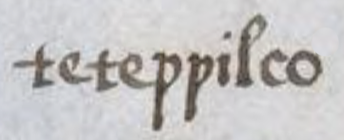
teteppilco
Tetepilco
Stephanie Wood
1551–1565
Jeff Haskett-Wood
genitales, mujer, mujeres
tepil(li), vulva, https://nahuatl.wired-humanities.org/content/tepilli
te(tl), stone, https://nahuatl.wired-humanities.org/content/tetl
-co (locative suffix), at or in, https://nahuatl.wired-humanities.org/content/co
quem(itl), a ritual bib, garments, or clothing, https://nahuatl.wired-humanities.org/content/quemitl
posiblemente, Lugar de Vulvas
Stephanie Wood
Library of Congress Online Catalog and the World Digital Library, Osuna Codex, or Painting of the Governor, Mayors, and Rulers of Mexico, https://www.loc.gov/resource/gdcwdl.wdl_07324/. The original is located in the Biblioteca Nacional de España.
"The Library of Congress is unaware of any copyright or other restrictions in the World Digital Library Collection. Absent any such restrictions, these materials are free to use and reuse." But please cite the Biblioteca Nacional de España and this Visual Lexicon of Aztec Hieroglyphs if you use any of these images here or refer to the content on this page, providing the URL.