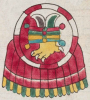
tilmatli (TK223r)
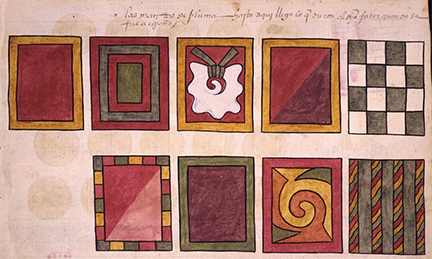
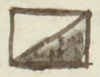
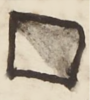
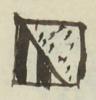
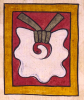
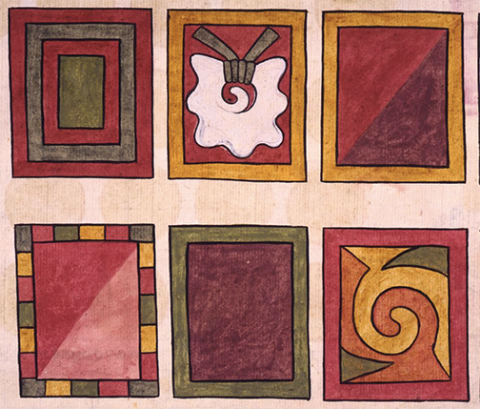
This painted example of iconography shows a group of blankets or cape (what we surmise to be tilmatli) in various designs and colors, all made out of feathers. These were cloths produced in Tepetlaoztoc and paid as tribute to a Spanish encomendero (a man who held a grant giving him the right to collect tribute in kind and in labor). He received these items as he was about to return to Spain. This sample of six textiles includes (top row, left to right): first, two concentric rectangles in green on a red background. Then comes a necklace made from a cross-section of a conch shell with an internal swirl, and a green tie on a red and gold background. Top right is a rectangle divided in half on the diagonal, with one half reddish brown and the other fully brown, plus a gold frame. In the lower row, from left to right, there is another rectangle divided in half on the diagonal, colored red and pink, and having a checkered border of green, red, and gold. Next is a brown rectangle with a green border, and finally, a golden swirl with an orange background, two possibly green leaves, and a red border. The contextualizing image shows a few more varieties, including a black and white checkerboard (upper right) and stripes in green alternating with multicolored stripes with diagonal patterns in red, gold, and green (in the lower right corner).
Stephanie Wood
The rectangles divided on the diagonal are reminiscent of some land parcels that appear in the Matrícula de Huexotzinco (below), but it is unclear if that shared design is intentional. The shell necklace is already a part of this digital collection. Swirls are very popular motifs in Nahua art, such as those seen in water, wind, and so on. Artistic “paintings” made from feathers are also well known in some museum collections, although this digital collection has mainly war shields made from feathers.
Stephanie Wood
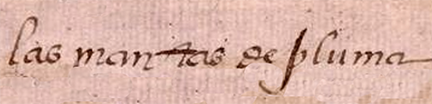
las mantas de pluma
Stephanie Wood
c. 1556
Jeff Haskett-Wood
telas, capas, tributo, tributos, resistencia, colonialismo, encomenderos
tilma(tli), blanket (in this case), https://nahuatl.wired-humanities.org/content/tilmatli
la manta
Stephanie Wood
The Codex Kingsborough, also known as the Códice de Tepetlaoztoc, and the Memorial de los indios de Tepetlaoztoc, is not on display. It was transferred from the British Library and is now held by the British Museum. It is shared on line at: https://www.britishmuseum.org/collection/object/E_Am2006-Drg-13964
©The Trustees of the British Museum. Shared under a Creative Commons Attribution-Non-Commercial-ShareAlike 4.0 International (CC BY-NC-SA 4.0) license. Please also cite the <em>Visual Lexicon of Aztec Hieroglyphsem>, ed. Stephanie Wood (Eugene, Ore.: Wired Humanities Projects, 2020-present) and this URL.