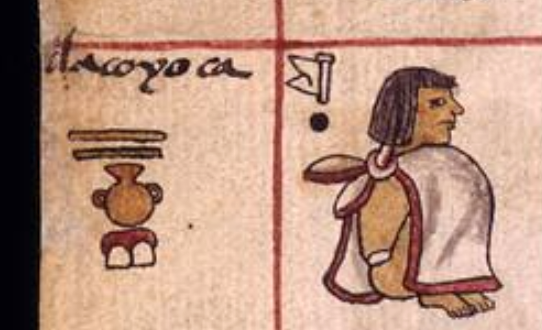
Tlacoyocan (TK204v)
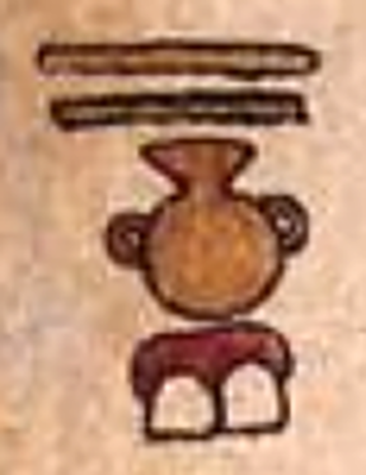
This compound Nahuatl hieroglyph for the place name Tlacoyocan (perhaps, “Where There Are Many Sticks”) includes three elements. The first one, at the bottom, is a pair of front teeth (tlantli) with a bit of red gums. This provides the phonetic syllable -tla- to start the place name. Above the teeth is a pottery jug (comitl), which provides the phonetic syllable -co- for the middle of the name. Finally, at the top are two horizontal sticks or wooden rods (tlacotl), a logogram apparently making a semantic contribution to the place name.
Stephanie Wood
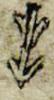
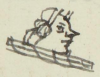
This is the first hieroglyph for Tlacoyocan to enter this digital collection (as of April 2026), but glyphs for tlacotl (typically meaning sticks or twigs) are known. See two examples below. Furthermore, glyphs for the term tlacotli (enslaved person) often involve a neck yoke attached to two sticks. These may well be osier twigs or other kinds of wooden rods.
Side Note: The folio numbers are not always clear in the copy published online by the British Museum. Marc Thouvenot gives this page the number K02_B in his TLACHIA digital collection, https://tlachia.iib.unam.mx/tepetlaoztoc/K02_B.
Stephanie Wood
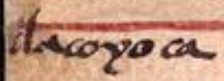
tlacoyoca
Tlacoyocan
Stephanie Wood
c. 1556
Jeff Haskett-Wood
madera, palo, rama, dientes, topónimo, topónimos, nombres de lugares, fonetismo, earthenware, ceramic, ceramics, cerámicas, jug, pot, olla, jarra, jarro, vessel, vessels, vasija de cerámica, cántaro, cántaros, xoctli, xoctepi, huicolli, atlacuihuani, tecomitl, tecontontli, apilolli
tlaco(tl), a stick, a rod, osier twig, https://nahuatl.wired-humanities.org/content/tlacotl
-yocan, where the preceding noun is abundant, https://nahuatl.wired-humanities.org/content/yocan
posiblemente, Donde Hay Muchos Palos o Ramitas
Stephanie Wood
The Codex Kingsborough, also known as the Códice de Tepetlaoztoc, and the Memorial de los indios de Tepetlaoztoc, is not on display. It was transferred from the British Library and is now held by the British Museum. It is shared on line at: https://www.britishmuseum.org/collection/object/E_Am2006-Drg-13964
©The Trustees of the British Museum. Shared under a Creative Commons Attribution-Non-Commercial-ShareAlike 4.0 International (CC BY-NC-SA 4.0) license. Please also cite the <em>Visual Lexicon of Aztec Hieroglyphsem>, ed. Stephanie Wood (Eugene, Ore.: Wired Humanities Projects, 2020-present) and this URL.