Tozcoatl (Verg44v)
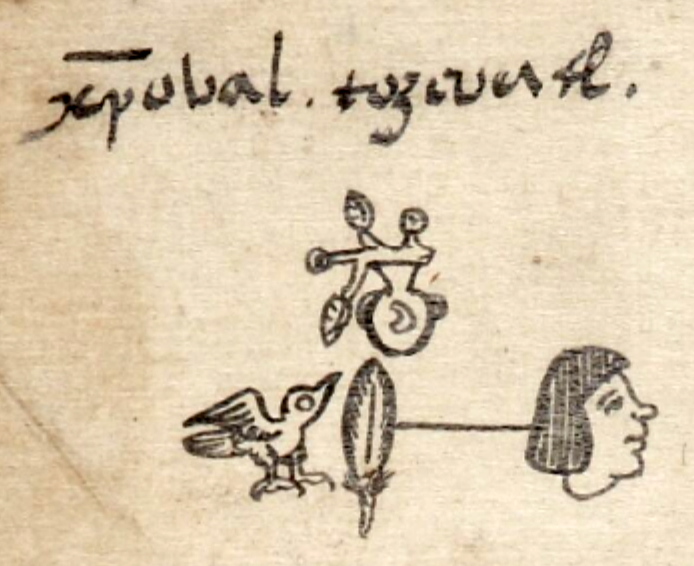
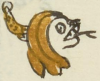
This compound Nahuatl hieroglyph is a black-line drawing of the personal name Tozcoatl (perhaps “Yellow Parrot-Serpent”), attested here as a man’s name. In this compound, the yellow-headed parrot (toztli) appears both as a bird (in profile, facing right, with its beak tipped up) and as a feather (vertical, with the calamus downward). Above the bird and feather are the elements of a pottery jug (comitl) with water (atl) spilling out. These are two phonetic indicators for coatl (serpent).
Stephanie Wood
This method for portraying the “coatl” part of the name may be a disguise, as the tlacuilos may have been aware of the colonial clergy’s opposition to the reverence held by Nahuas for the snake and their continuing use of the religious divinatory calendar for naming children. Coatl was a day sign in that 260-day calendar (tonalpohualli). Furthermore, serious events in Tetzcoco in 1539 may have made Nahua tlacuilos more cautious when writing and painting about aspects of their faith. See Patricia Lopes Don for information about the Inquisition case against don Carlos Ometochtli, a Chichimecatecuhtli (or Chichimecateuctli) executed in late 1539, in Bonfires of Culture, 2010. Bradley Benton (The Lords of Tetzcoco, 2017, 46) also writes that the case “demonstrates that blatant disregard for Christianity had serious consequences.” One other hieroglyph in this collection for the personal name Tozcatl, from Huexotzinco, does include a snake. See below.
Stephanie Wood
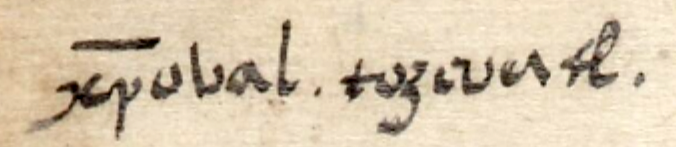
xpovāl. tozcoatl.
Cristóbal Tozcoatl
Stephanie Wood
1539
Jeff Haskett-Wood
serpientes, loros, pájaro, pájaros, agua, barro, colores, amarillo, nombres de hombres, men’s names, fonetismo, earthenware, ceramic, ceramics, cerámicas, jug, pot, olla, jarra, jarro, vessel, vessels, vasija de cerámica, cántaro, cántaros, xoctli, xoctepi, huicolli, atlacuihuani, tecomitl, tecontontli, apilolli
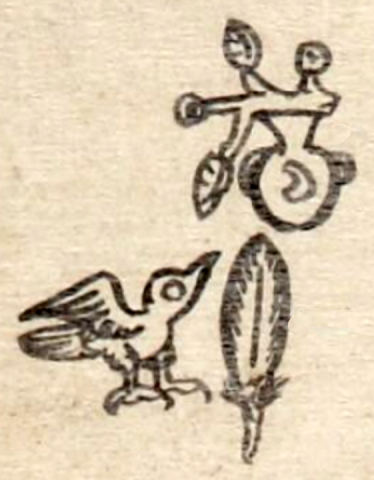
toz(tli), yellow-headed parrot, https://nahuatl.wired-humanities.org/content/toztli
comi(tl), pottery jug or pot, https://nahuatl.wired-humanities.org/content/comitl
a(tl), water, https://nahuatl.wired-humanities.org/content/atl
coa(tl), serpent, https://nahuatl.wired-humanities.org/content/coatl
posiblemente, Loro Amarillo-Serpiente
Stephanie Wood
Available at Codex Vergara, folio 44r, https://gallica.bnf.fr/ark:/12148/btv1b84528032/f96.item.zoom, accessed 25 March 2026. The Vergara is associated with Tepetlaoztoc, in the larger region of Tetzcoco, c. 1539–1543. “Source gallica.bnf.fr / BnF.” We would also appreciate a citation to the Visual Lexicon of Aztec Hieroglyphs, https://aztecglyphs.wired-humanities.org/.
Image Rights: The non-commercial reuse of images from the Bibliothèque nationale de France is free as long as the user is in compliance with the legislation in force and provides the citation: “Source gallica.bnf.fr / Bibliothèque nationale de France” or “Source gallica.bnf.fr / BnF.” We would also appreciate a citation to the Visual Lexicon of Aztec Hieroglyphs, https://aztecglyphs.wired-humanities.org/