Tzilacatzin (FCbk12f59v)
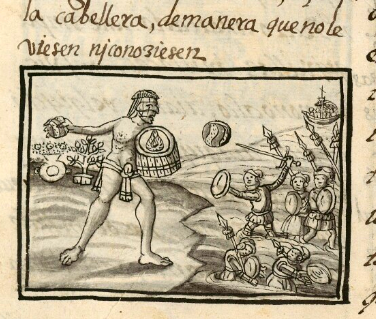
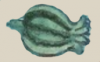
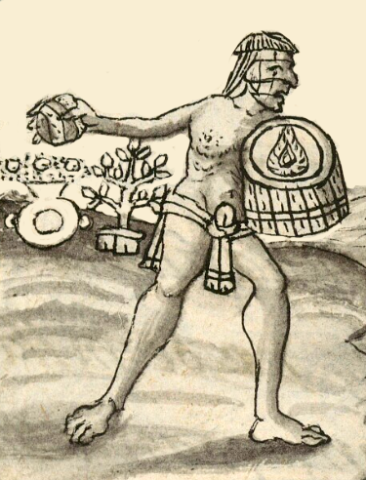
This iconographic example, featuring a black and white sketch of a person named Tzilacatzin, is included in this digital collection for the purpose of making comparisons with related hieroglyphs. The term selected for this example comes from the text near the image in the Digital Florentine Codex. There is no gloss, per se. This man was famous for resisting the Spanish invasion and having success in battles by throwing stones so ferociously that he killed some Spaniards this way. His name may have referred to a soft squash, but he was apparently very muscular. He wore only a loincloth, and his face was painted in vertical and horizontal lines. The Spanish-language text explains that his weapons and insignia were in the style of an Otomí. The stone he holds in his right hand is a simplex hieroglyph for tetl (stone), with its two-tone stripes. Below his right arm, on the landscape, are what also appear to be two other hieroglyphs. One is a jug of water, and the other is a plant. They may spell out his name, which refers to the chilcayotl, a soft squash. On folio 60 recto Tzilacatzin is said to have had the rank of Otomí warrior, wore the Otomí hairstyle, and would put on his lip pendant, golden ear plugs, and shell necklace. On 60 verso, the lore about Tzilacatzin’s prowess continues. He had golden leg and arm bands, and sometimes he wore a hairpiece or wig with eagle feathers tied at the back of his neck.
Stephanie Wood
This digital collection includes several examples of men with face paint or tattoos with these crossing lines on the face. See below.
Stephanie Wood
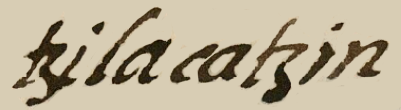
tzilacatzin
Tzilacatzin
Stephanie Wood
1577
Jeff Haskett-Wood
face paint, pintura de la cara, tatuaje, Otomí, otomíes, resist
tzilacayo(tl), chilcayote, a soft squash, https://nahuatl.wired-humanities.org/content/tzilacayotl
[el nombre de un famoso defensor de la capital frente a los españoles]
Stephanie Wood
Available at Digital Florentine Codex/Códice Florentino Digital, edited by Kim N. Richter and Alicia Maria Houtrouw, "Book 12: Conquest of Mexico", fol. 59v, Getty Research Institute, 2023. https://florentinecodex.getty.edu/en/book/12/folio/59v/images/0 Accessed 7 February 2026.
Images of the digitized Florentine Codex are made available under the following Creative Commons license: CC BY-NC-ND (Attribution-NonCommercial-NoDerivs 4.0 International). For print-publication quality photos, please contact the Biblioteca Medicea Laurenziana ([email protected]). The Library of Congress has also published this manuscript, using the images of the World Digital Library copy. “The Library of Congress is unaware of any copyright or other restrictions in the World Digital Library Collection. Absent any such restrictions, these materials are free to use and reuse.”