visorey (Osu21r)
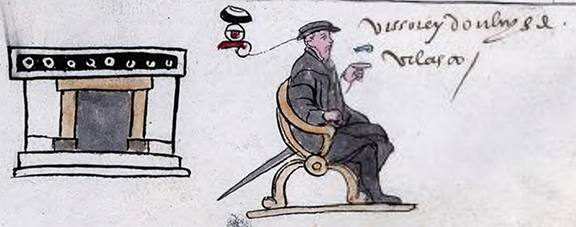
This painted compound Nahuatl hieroglyph represents the title of viceroy (visorrey, a loanword that entered Nahuatl from Spanish and an archaic form of virrey). The term refers to a vice-king, the most powerful colonial administrator. The compound contains three elements. One is a speech scroll (tlatoa, to speak), which seems to provide the semantic meaning of tlatoani (ruler, literally the one who speaks). Up from there is an eye (ixtli), which may provide the phonetic -ix- for the “is” in visorrey. Finally, the bean (etl) at the top supplies the phonetic syllable -e- for the ending of the word, “ey.”
Stephanie Wood
Unlike the other compound glyph for visorrey on folio 15r of this same codex, this one has coloring: a red pupil on the eye, and the first half of the speech scroll is red (the curling part is white). Note how the tlatoa scroll refers not to a Nahua tlatoani (the norm) but to a Spaniard. The contextualizing image shows how this powerful man is the viceroy don Luis de Velasco. He was one of the more popular and best remembered viceroys in local histories (títulos primordiales) written in Nahuatl. The iconography of his power is rooted in his curule chair and the way he gestures with the index figure on his left hand (a phenomenon that the Nahuas usually called mapilhuia). Behind the viceroy is what one might call a tecpan, a ruler’s palace, which stands out because of the row of white circles with dots (much like water droplets or beads) across the front, above the entryway. This is another symbol of his governing role.
Stephanie Wood
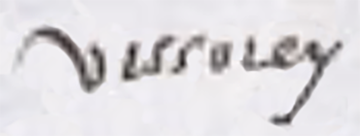
vissoley
visorrey
Stephanie Wood
1551–1565
Jeff Haskett-Wood
mapilhuia, dedo, señalar, poder, virrey, nombres de hombres, nombres de españoles

visorrey, viceroy (a loan from Spanish), https://nahuatl.wired-humanities.org/content/visorrey
tlatoa, to speak, https://nahuatl.wired-humanities.org/content/tlatoa
ix(tli), eye, https://nahuatl.wired-humanities.org/content/ixtli
e(tl), bean, https://nahuatl.wired-humanities.org/content/etl
el virrey
Stephanie Wood
Library of Congress Online Catalog and the World Digital Library, Osuna Codex, or Painting of the Governor, Mayors, and Rulers of Mexico, https://www.loc.gov/resource/gdcwdl.wdl_07324/. The original is located in the Biblioteca Nacional de España.
"The Library of Congress is unaware of any copyright or other restrictions in the World Digital Library Collection. Absent any such restrictions, these materials are free to use and reuse." But please cite the Biblioteca Nacional de España and this Visual Lexicon of Aztec Hieroglyphs if you use any of these images here or refer to the content on this page, providing the URL.