xiquipilli (TR37v)
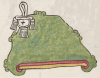
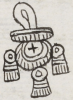
This element has been taken from the compound place name, Xiquipilco (a place that got its name as a source of the special bag called the xiquipilli). This is looping-handled bag with a horizontal fringe below the loop, and three tassels, one on each side and one at the bottom of the bag. The tassels vaguely resemble the glyph for rain (quiyahuitl), but upside-down. The front of the bag has a cross (+) in the middle of a white area. While this may seem European, this shape existed in Mesoamerican cultures from prior to contact.
Stephanie Wood
The xiquipilli sack was a traditional bag that usually held either cacao beans or incense, probably 8,000 pieces, given that the bag ended up serving to represent the number eight thousand. It may have also come to hold pieces of gold and, once they were introduced by Europeans, coins. It is unclear here what material went into its construction, but cotton was a pre-Columbian fiber that was used widely in Mesoamerica before and after contact with Europeans.
Stephanie Wood
1578
Jeff Haskett-Wood
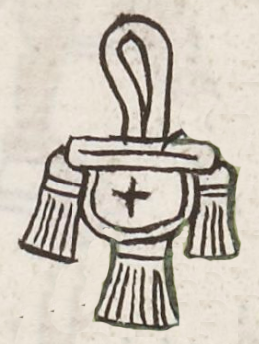
xiquipil(li), a special sack or bag for cacao beans or incense, https://nahuatl.wired-humanities.org/content/xiquipilli
The Codex Telleriano-Remensis is hosted on line by the Bibliothèque nationale de France.
https://gallica.bnf.fr/ark:/12148/btv1b8458267s/f100.item. We have taken this detail shot from folio 37 verso.
This manuscript is not copyright protected, but please cite Gallica, the digital library of the Bibliothèque nationale de France or cite this Visual Lexicon of Aztec Hieroglyphs, ed. Stephanie Wood (Eugene, Ore.: Wired Humanities Projects, 2020–present).