xoloitzcuintli (FCbk11f17r)
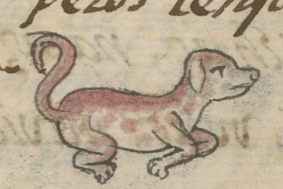
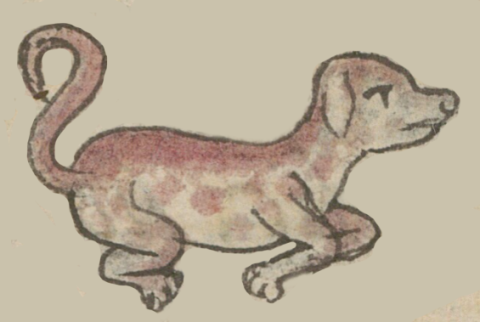
This iconographic example, featuring a dog (xoloitzcuintli), is included in this digital collection for the purpose of making comparisons with related hieroglyphs. The term selected for this example comes from the text near the image in the Digital Florentine Codex. There is no gloss, per se. This example shows a short-legged dog in profile, resting or running, but facing the viewer’s right. It has pink or red on its back and pink spots on its sides. It does not appear to be a dark gray hairless dog, which is what Wikipedia shows for the xoloitzcuintli breed.
Stephanie Wood
Incluimos en nuestra colección digital este ejemplo iconográfico de un perro (xoloitzcuintli) para poder compararlo con otros jeroglíficos relacionados. El término elegido para este ejemplo proviene del texto cerca de la imagen en el Códice Florentino Digital, no cuenta con una glosa en sí y nos muestra un perro paticorto de perfil, yaciente o a la carrera, que mira hacia la derecha del espectador. El can está coloreado de rosa o rojo en su lomo y tiene manchas rosáceas en su costado; no parece tratarse de un perro pelón de color gris oscuro, que es lo que el artículo de Wikipedia nos muestra como un xoloitzcuintli.
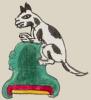
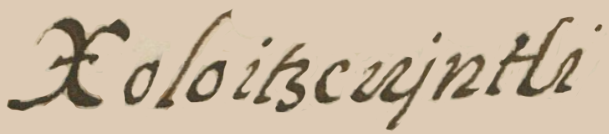
In this collection, there are two relevant comparisons. One is the group of hieroglyphs and iconographic examples that show the itzcuintli dog, and the other group refers to Xolotl (an ancestor and deity-like figure) which also appears to be a dog or have canine qualities. One itzcuintli is white with black spots, echoing the chichi (and both come from the Codex Mendoza). Note the interesting calligraphy in the uppercase X of the term, xoloitzcuintli, with its crossbar.
Stephanie Wood
Contamos con dos comparaciones pertinentes en nuestra colección: la primera es el grupo de jeroglíficos y ejemplos iconográficos del can itzcuintli, mientras que la segunda son los ejemplos que se refieren a Xolotl, un ancestro y una entidad de traza divina que también parece ser un perro o tener características caninas. Uno de los itzcuintli es blanco con manchas negras, en referencia al chichi (y ambos provienen del Códice Mendocino). Nótese la interesante caligrafía de la equis mayúscula del término xoloitzcuintli con su raya transversal.
Xoloitzcuintli
xoloitzcuintli
Stephanie Wood
1577
Jeff Haskett-Wood
perros, animales
xoloitzcuin(tli), dog, https://nahuatl.wired-humanities.org/content/xoloitzcuintli
una raza de perro autóctona
Stephanie Wood
Available at Digital Florentine Codex/Códice Florentino Digital, edited by Kim N. Richter and Alicia Maria Houtrouw, "Book 11: Earthly Things", fol. 17r., Getty Research Institute, 2023. https://florentinecodex.getty.edu/en/book/11/folio/17r/images/0 Accessed 7 October 2025.
Images of the digitized Florentine Codex are made available under the following Creative Commons license: CC BY-NC-ND (Attribution-NonCommercial-NoDerivs 4.0 International). For print-publication quality photos, please contact the Biblioteca Medicea Laurenziana ([email protected]). The Library of Congress has also published this manuscript, using the images of the World Digital Library copy. “The Library of Congress is unaware of any copyright or other restrictions in the World Digital Library Collection. Absent any such restrictions, these materials are free to use and reuse.”