Xoxocoyol (Verg40r)
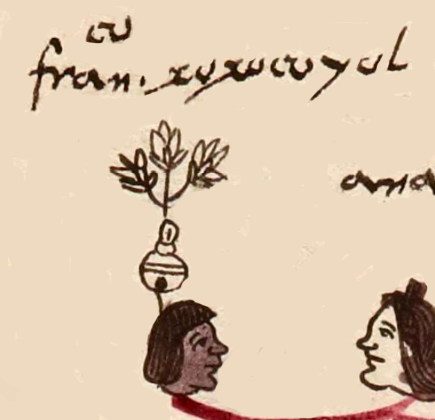
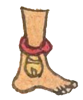
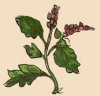
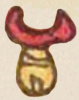
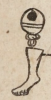
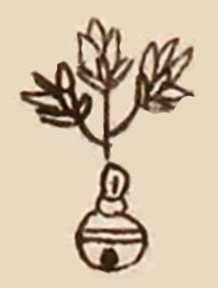
This compound Nahuatl hieroglyph is a black-line drawing of the personal name Xoxocoyol (“Sorrel”), the name of a famous Mexica ruler. It is attested here as the name of a macehualli, a tribute payer’s name. The compound includes two elements, a sorrel plant (called both xocoyolli or xoxocoyolli) and a bell (coyolli). The bell is a phonetic complement that helps the reader know which plant is shown, providing half the name of the plant in two syllables read phonetically.
Stephanie Wood
According to ethnobotanist Richard Tan, xocoyoles (as the term has been Hispanized) are "a large class of plants with a characteristic sourness, used to flavor dishes," although they can also be enjoyed by just munching on the leaves when one is out in the field. He says they are also referred to in Spanish as agritos, because of their sour taste. He adds that “[m]any Begonia species are xocoyoles, but many edible Oxalis species are, too." (Personal communication 9 March 2022.)
Stephanie Wood
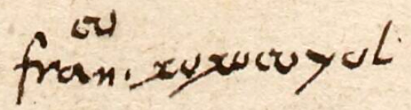
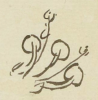
franco. xoxocoyol
Francisco Xoxoyol
Stephanie Wood
1539
Jeff Haskett-Wood
plantas, alazán, campanilla, campanillas, campana, campanas, cascabel, cascabeles, jingle bells, nombres de hombres, men’s names, fonetismo
xocoyol(li), sorrel or woodsorrel, https://nahuatl.wired-humanities.org/content/xocoyolli
xoxocoyol(li), sorrel or woodsorrel, https://nahuatl.wired-humanities.org/content/xoxocoyolli
xococ, something sour, https://nahuatl.wired-humanities.org/content/xococ
coyol(li), a bell, https://nahuatl.wired-humanities.org/content/coyolli
Alazán, Jojocoyol, o Xocoyole
Stephanie Wood
Available at Codex Vergara, folio 40r, https://gallica.bnf.fr/ark:/12148/btv1b84528032/f87.item.zoom, accessed 10 March 2026. The Vergara is associated with Tepetlaoztoc, in the larger region of Tetzcoco, c. 1539–1543. “Source gallica.bnf.fr / BnF.” We would also appreciate a citation to the Visual Lexicon of Aztec Hieroglyphs, https://aztecglyphs.wired-humanities.org/.
Image Rights: The non-commercial reuse of images from the Bibliothèque nationale de France is free as long as the user is in compliance with the legislation in force and provides the citation: “Source gallica.bnf.fr / Bibliothèque nationale de France” or “Source gallica.bnf.fr / BnF.” We would also appreciate a citation to the Visual Lexicon of Aztec Hieroglyphs, https://aztecglyphs.wired-humanities.org/