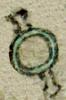
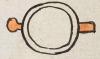
Yaotl (Verg26v)
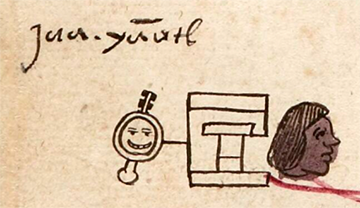
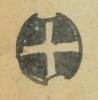
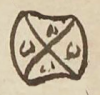
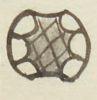
This simplex Nahuatl hieroglyph is a black-line drawing of the personal name Yaotl (probably “Combatant”), attested here as a man’s name. It shows a war shield with a macuahuitl (obsidian-studded club) behind it, which combines as the symbol for warfare. The name Yaotl attests abundantly across regions. The design of this shield is especially notable for the way an earlier design has been turned into a happy face, with human eyes and, here, a mouth with teeth showing. Another Yaotl glyph from the Vergara is similar (see folio 11 recto), but the teeth are not demarcated. Yaotl glyphs from the Matrícula de Huexotzinco have different shields, such as a T-shaped cross and an X-shaped cross, or a turtle-shell pattern. The Yaotl signs from the Beinecke Map and the Codex Mendoza are more like this one, except that the round shield is blank.
Stephanie Wood
The smiley-face shield may be a take-off on the cuexyo shield design. Is it an effort to make a possibly threatening name seem more benign? On the other hand, European crests sometimes had faces on them, so perhaps this was learned from colonial instructors. The Codex Azcatitlan (Library of Congress, Image #30) shows Pedro de Alvarado (“Tonatiuh”) carrying a shield with a face in profile. In the latter, the face of the sun may be implied, given the use of suns as a heraldic charge in medieval and Renaissance art. See, for example, the fifteenth-century Book of Hours in France. Faces on European shields can also represent Christ or saints.
Stephanie Wood
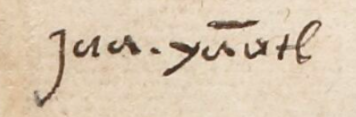
jua.yāotl
Juan Yaotl
Stephanie Wood
1539
Jeff Haskett-Wood
guerrero, guerreros, combatientes, guerra, conflicto, conflictos, armas, escudo, escudos, nombres de hombres, men’s names

yao(tl), enemy, or combatant, https://nahuatl.wired-humanities.org/content/yaotl
Combatiente
Stephanie Wood
Available at Codex Vergara, folio 26v,
https://gallica.bnf.fr/ark:/12148/btv1b84528032/f60.item.zoom, accessed 22 February 2026. The Vergara is associated with Tepetlaoztoc, in the larger region of Tetzcoco, c. 1539–1543. “Source gallica.bnf.fr / BnF.” We would also appreciate a citation to the Visual Lexicon of Aztec Hieroglyphs, https://aztecglyphs.wired-humanities.org/.
Image Rights: The non-commercial reuse of images from the Bibliothèque nationale de France is free as long as the user is in compliance with the legislation in force and provides the citation: “Source gallica.bnf.fr / Bibliothèque nationale de France” or “Source gallica.bnf.fr / BnF.” We would also appreciate a citation to the Visual Lexicon of Aztec Hieroglyphs, https://aztecglyphs.wired-humanities.org/