yaotl (Verg42r)
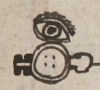
This element, which is a black-line drawing of a war club and shield, has been carved from the compound personal name Yaotlachia (“The Combatant Looks” or the “Enemy Watches”). Yaotl typically means combatant or enemy, but in this ase the sign could also be read as warfare (yaoyotl). Either way, the element provides the logographic indication that the name begins with Yao-. The element combines a circular war shield (chimalli) with a horizontal, wooden club (macuahuitl), similar to the mitl chimalli visual diphrasis that is also a reference to war. The club has a round ball-shaped handle and rectangular obsidian blades embedded in the end away from the handle. This war shield has a somewhat unusual design, with four dots in a square arrangement inside the circle.
Stephanie Wood
If the shield were a coin, it might look something like a tostón (Spanish for a half peso, the same as four eighths of a peso). The eighths were called tomines in Spanish, and all these words, tostón, tomín, and tomines, entered Nahuatl as loanwords. One complication, however, is that a coin worth four tomines would more likely bear the digit “4” in the middle of the circle instead of the four dots. See the arrangement below, showing how seven tomines are expressed as a half peso–bearing the digit 4–and another coin with three dots, representing three tomines. It is unclear why this tlacuilo would draw a war shield with dots on it. As of yet (March 2026), there are no war shields in this collection with four dots on them, whether arranged as shown or another way. Another shield on folio 47 verso has four tiny horizontal lines. So perhaps the idea was just to put something to fill the space that would give a vague suggestion of a design. Was the tlacuilo forgetting the standard designs, or was this was an effort to disguise the war shield and make it less threatening?
Stephanie Wood
Stephanie Wood
1539
Jeff Haskett-Wood
escudos, macana, macanas, hoja de obsidiana, hojas de obsidiana, madera, elemento de un jeroglífico compuesto

yao(tl), combatant or enemy, https://nahuatl.wired-humanities.org/content/yaotl
el combatiente, o el enemigo
Stephanie Wood
Available at Codex Vergara, folio 42r, https://gallica.bnf.fr/ark:/12148/btv1b84528032/f91.item.zoom, accessed 14 March 2026. The Vergara is associated with Tepetlaoztoc, in the larger region of Tetzcoco, c. 1539–1543. “Source gallica.bnf.fr / BnF.” We would also appreciate a citation to the Visual Lexicon of Aztec Hieroglyphs, https://aztecglyphs.wired-humanities.org/.
Image Rights: The non-commercial reuse of images from the Bibliothèque nationale de France is free as long as the user is in compliance with the legislation in force and provides the citation: “Source gallica.bnf.fr / Bibliothèque nationale de France” or “Source gallica.bnf.fr / BnF.” We would also appreciate a citation to the Visual Lexicon of Aztec Hieroglyphs, https://aztecglyphs.wired-humanities.org/