Yaotlachia (Verg42r)
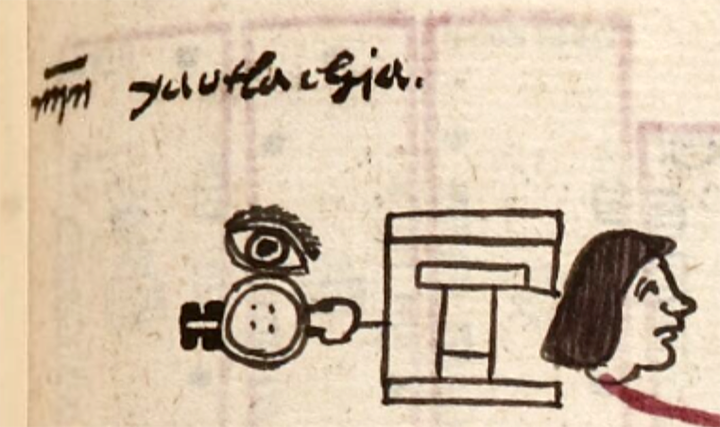
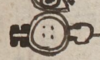
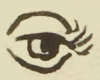
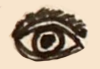
This compound Nahuatl hieroglyph is a black-line drawing of the personal name Yaotlachia (perhaps “The Combatant Looks” or the “Enemy Watches”), attested here as a man’s name. The compound consists of two elements. The first element is a sign for warfare that is represented by a shield and, behind it, an obsidian-studded club called a macuahuitl. This is the logogram for warfare (yaoyotl). But, in case just yaotl is intended here, then yaotl could be translated as “combatant” or “enemy.” Above this sign is an open eye in a frontal view and drawn in a European manner. It is replete with eyelashes, a pupil, and an iris. It is very different from the starry eye of the Codex Mendoza, for example, and yet this manuscript is from the same era. This eye is a semantic indicator for the verb tlachia (to look), as expressed in the gloss.
Stephanie Wood
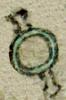
See some examples of yaotl and yaoyotl below. There is also one hieroglyph for Tlachia in this collection (as of late March 2026).
Stephanie Wood
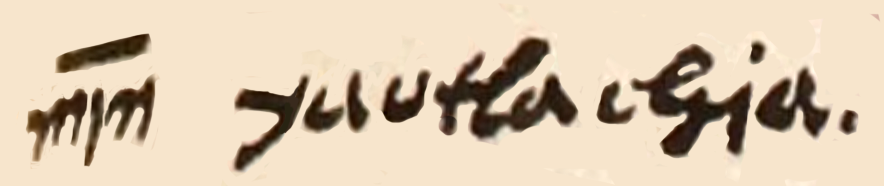
mīn yaotlachia.
Martín Yaotlachia
Stephanie Wood
1539
Jeff Haskett-Wood
escudo, escudos, guerra, combate, combatiente, combatientes, enemigo, enemigos, ojo, ojos, ver, look, observar, mirar, nombres de hombres, men’s names, fonetismo
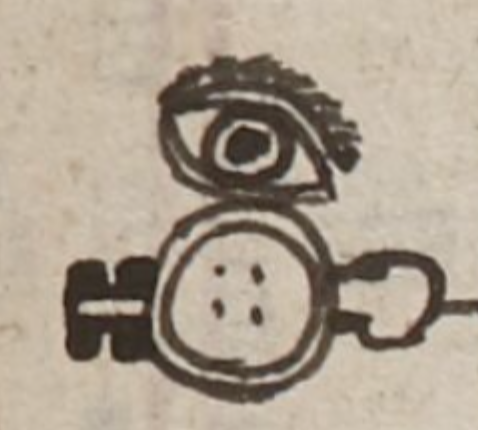
yao(tl), combatant or enemy, https://nahuatl.wired-humanities.org/content/yaotl
tlachia, to look, https://nahuatl.wired-humanities.org/content/tlachia
posiblemente, El Combatiente Observa, o El Enemigo Mira
Stephanie Wood
Available at Codex Vergara, folio 42r, https://gallica.bnf.fr/ark:/12148/btv1b84528032/f91.item.zoom, accessed 14 March 2026. The Vergara is associated with Tepetlaoztoc, in the larger region of Tetzcoco, c. 1539–1543. “Source gallica.bnf.fr / BnF.” We would also appreciate a citation to the Visual Lexicon of Aztec Hieroglyphs, https://aztecglyphs.wired-humanities.org/.
Image Rights: The non-commercial reuse of images from the Bibliothèque nationale de France is free as long as the user is in compliance with the legislation in force and provides the citation: “Source gallica.bnf.fr / Bibliothèque nationale de France” or “Source gallica.bnf.fr / BnF.” We would also appreciate a citation to the Visual Lexicon of Aztec Hieroglyphs, https://aztecglyphs.wired-humanities.org/