Yecatl (TK206v)
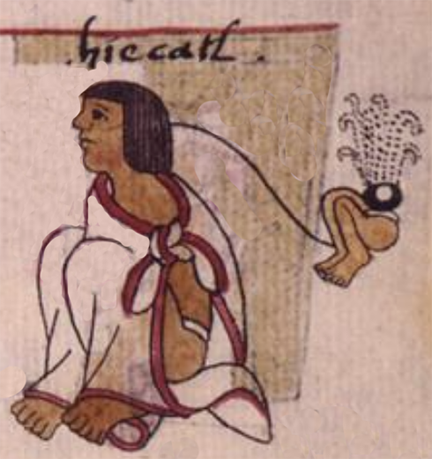
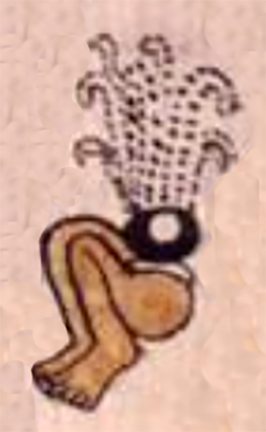
This painted compound Nahuatl hieroglyph represents the personal name Yecatl, sometimes also spelled Ecatl and Ehecatl, attested as a man’s name. Regardless of the spelling, it likely refers to the divine force of the wind Ehecatl. The compound has three elements, and the reading is multidirectional. It could start with the bean (etl) in the middle, which supplies the phonetic syllable -e- as a starting point. Dots swirl upwards from the bean in the shape of a fountain of water, but this apparently represents moving air or wind (ehecatl). Finally, the lowest element is the lower part (tzintli) of a man’s body, which usually indicates the phonetic syllable -tzin. Given that this is not only a person’s name but it is shared with a sacred force, the -tzin is likely meant as a reverential suffix. The gloss does not include the -tzin, but perhaps it should have.
Stephanie Wood
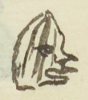
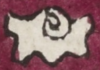
Below are some other examples where the usual spelling of Ecatl has the added Y- at the start. The swirl in the shell (yecacozcayo) was apparently reminiscent of a whirlwind. Whirlpools and whirlwinds were something special for Nahuas. Far more numerous among the records in this collection are those for the “Ecatl” spelling, as a Quick Search will confirm.
Side Note: The folio numbers are not always clear in the copy published online by the British Museum. Marc Thouvenot gives this page the number K04_B in his TLACHIA digital collection, https://tlachia.iib.unam.mx/tepetlaoztoc/K04_B.
Stephanie Wood
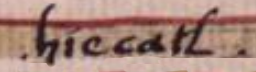
.hiecatl.
Yecatl (an alternate spelling for Ecatl or Ehecatl)
Stephanie Wood
c. 1556
Jeff Haskett-Wood
aries, frijol, frijoles, trasero, traseros, nombres de hombres, men’s names, nombres de deidades, fonetismo
eca(tl), air or breath, https://nahuatl.wired-humanities.org/content/ecatl
eheca(tl), wind, https://nahuatl.wired-humanities.org/content/ehecatl
e(tl), bean, https://nahuatl.wired-humanities.org/content/etl
Aire o Viento
Stephanie Wood
The Codex Kingsborough, also known as the Códice de Tepetlaoztoc, and the Memorial de los indios de Tepetlaoztoc, is not on display. It was transferred from the British Library and is now held by the British Museum. It is shared on line at: https://www.britishmuseum.org/collection/object/E_Am2006-Drg-13964
©The Trustees of the British Museum. Shared under a Creative Commons Attribution-Non-Commercial-ShareAlike 4.0 International (CC BY-NC-SA 4.0) license. Please also cite the <em>Visual Lexicon of Aztec Hieroglyphsem>, ed. Stephanie Wood (Eugene, Ore.: Wired Humanities Projects, 2020-present) and this URL.