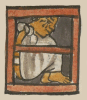
Huatzal (MH518v)
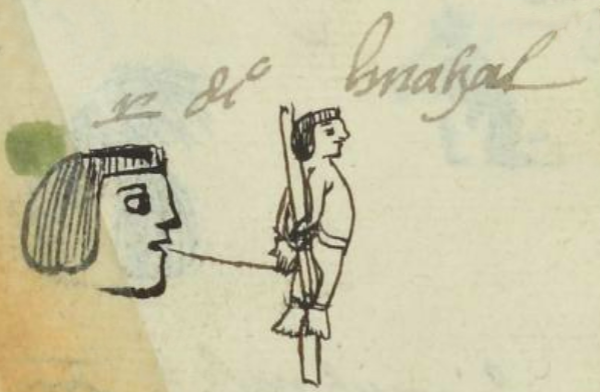
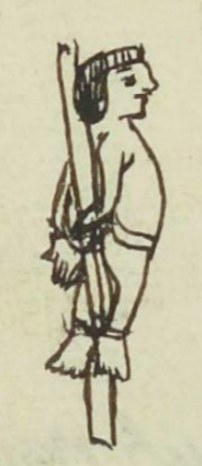
This black-line drawing of the simplex Nahuatl hieroglyph for the personal name Huatzal ("Tied Tightly," attested here as a man's name) shows a man in profile, wearing only a loincloth and facing toward the viewer's right, tied to a post. His feet are above the bottom of the stick, so this means that he is suspended above the ground.
Stephanie Wood
Este dibujo de trazos negros del jeroglífico simple náhuatl utilizado para designar el nombre propio Huatzal (“Atado Fuertemente”) se registra aquí como el nombre de una persona y nos muestra a un hombre de perfil, vestido únicamente con un taparrabos, atado a un poste y mirando hacia la derecha del espectador. Sus pies aparecen encima del extremo inferior del palo, lo cual significa que está suspendido y sin tocar el suelo.
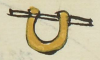
The name Huatzal is also attested in Morelos (see S. L. Cline, The Book of Tributes, 1993, 173). While Alonso de Molina refers to the term huatzalli only in reference to the drying of fruit (see the Online Nahuatl Dictionary), something else is happening in this glyph. Perhaps fruit was put on stakes in the sun to dry, and this act could be stretched to the tying and suspending of a person on a stake. Orozco y Berra (1880, 468) provides another definition for Huatzal, as "tied very tightly." The state of being tied to a post appears to be a punishment. Juan José Batalla Rosado (2018, 99) shares some examples of stocks and wooden neck-locks that were put on enslaved people or people undergoing a type of imprisonment--one being a European method and one Indigenous.
Stephanie Wood
El nombre propio Huatzal también se registra en Morelos (véase S. L. Cline, The Book of Tributes, 1993, p. 173). Aunque Alonso de Molina utiliza el término huatzalli únicamente para referirse al secado de frutos (véase el Online Nahuatl Dictionary), lo que vemos en este glifo es distinto: quizá se colocaban frutos en postes para secarlos al sol, lo cual podría relacionarse con el acto de atar y suspender de un palo a una persona. Orozco y Berra (1880, p. 468) nos proporciona otra definición para Huatzal: “atado muy fuertemente”. Parece tratarse de un castigo: Juan José Batalla Rosado (2018, p. 99) proporciona ejemplos de cepos de madera para pies, manos y cuellos que se utilizaban con los esclavos o con personas que sufrían algún tipo de prisión, con un método europeo y otro indígena.
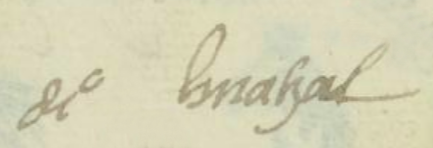
dio huatzal
Diego Huatzal
Stephanie Wood
1560
Stephanie Wood
castigos, cepos, nombres de hombres, men's names
huatzal(li), something tied very tightly, https://nahuatl.wired-humanities.org/content/huatzalli
Atado Fuertemente
Stephanie Wood
Matrícula de Huexotzinco, folio 518v, World Digital Library, https://www.loc.gov/resource/gdcwdl.wdl_15282/?sp=116&st=image
This manuscript is hosted by the Library of Congress and the World Digital Library; used here with the Creative Commons, “Attribution-NonCommercial-ShareAlike 3.0 License” (CC-BY-NC-SAq 3.0).