mecatl (FCbk8f26r)
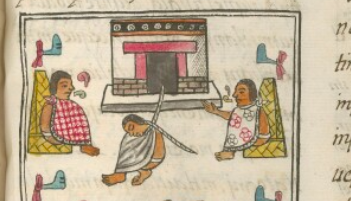
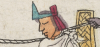
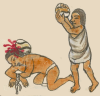
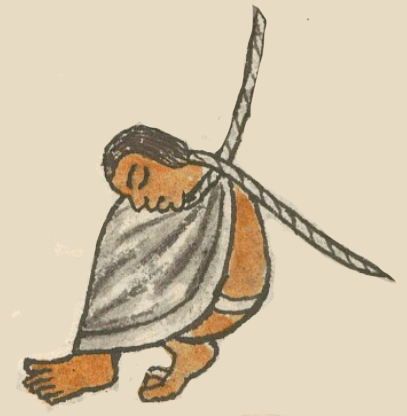
This iconographic example, featuring a rope or cord (mecatl) is included in this digital collection for the purpose of making comparisons with related hieroglyphs The term selected for this example comes from the keywords chosen by the team behind the Digital Florentine Codex. There is no gloss. This example shows a rope that is wrapped around the neck of a man who is deceased, suggesting that he has been strangled with the rope or cord. His eyes are closed and his head hangs down, facts which suggest that he is dead. He has black hair and brown skin. He wears a white cape that has gray areas of shading that give it a three-dimensionality. The contextualizing image shows his sitting on the ground between two rulers (tlatoque, or tlahtoqueh, with the glottal stops) who are also lords, given the diadem above their heads that is the sign of the word for lord (<<>em>teuctli or em>tecuhtli).
Stephanie Wood
Incluimos en nuestra colección digital este ejemplo iconográfico de un cordel o cuerda (mecatl) para poder compararlo con otros jeroglíficos relacionados. El término seleccionado para este ejemplo proviene de las palabras clave elegidas por el equipo del Códice Florentino Digital y no cuenta con una glosa. Se nos muestra una cuerda enrollada alrededor del cuello de un hombre de ojos cerrados y cabeza inclinada sobre el pecho, todo lo cual indica que ha muerto estrangulado con la cuerda o cordel. La víctima tiene cabellos negros y una piel marrón y está vestida con una tilma blanca con sombreado gris, lo cual le da una calidad tridimensional. La imagen contextual lo muestra sentado en el suelo entre dos gobernantes (tlatoque o tlahtoqueh con las oclusivas glotales) que también son señores nobles, como indican las diademas sobre sus cabezas, el signo de la palabra teuctli o tecuhtli, “señor”.
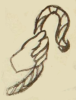
Ropes are often white and have diagonal lines that suggest they are some kind of twisted fiber. They were used for a variety of purposes, such as pulling or hauling something, hanging or strangling people, tying shrouds on corpses, and much more.
Stephanie Wood
Las cuerdas frecuentemente se plasman de color blanco y con líneas diagonales que indican que estaban hechas de algún tipo de fibra retorcida. Se utilizaban para una amplia variedad de actividades: jalar o izar objetos, ahorcar o estrangular personas, atar los sudarios de los difuntos y mucho más.
1577
Jeff Haskett-Wood
soga, sogas, cordón, cordones, cuerda, cuerdas, estrangular, matar, muerte, morir, ejecutar, ejecución, paliza, escarmiento, castigo
meca(tl), rope or cord, https://nahuatl.wired-humanities.org/content/mecatl
la soga
Stephanie Wood
Available at Digital Florentine Codex/Códice Florentino Digital, edited by Kim N. Richter and Alicia Maria Houtrouw, "Book 8: Kings and Lords", fol. 26r, Getty Research Institute, 2023. https://florentinecodex.getty.edu/en/book/8/folio/26r/images/0 Accessed 9 August 2025.
Images of the digitized Florentine Codex are made available under the following Creative Commons license: CC BY-NC-ND (Attribution-NonCommercial-NoDerivs 4.0 International). For print-publication quality photos, please contact the Biblioteca Medicea Laurenziana ([email protected]). The Library of Congress has also published this manuscript, using the images of the World Digital Library copy. “The Library of Congress is unaware of any copyright or other restrictions in the World Digital Library Collection. Absent any such restrictions, these materials are free to use and reuse.”