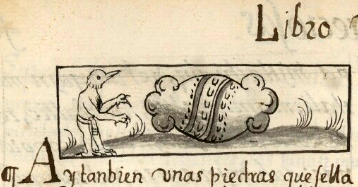
teotetl (FCbk11f209v)
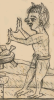
This compound hieroglyph features a jet stone (teotetl). The term selected for this example comes from the text near the image in the Digital Florentine Codex. There is no gloss, per se. This compound has two elements. One is a standing human-bird figure on the left representing teotl (a sacred force). It is shown in profile, facing right. It wears a man’s loincloth. Unlike a bird, it has four claws, but its head has a large beak. The “front claws” are very sharp, and these arms or legs are bent at what could be the elbows. The way the tlacuilo draws this teotl seems to suggest an Indigenous Christian way of thinking about the ancestral concept, making teotl into something like a tlacatecolotl (human-owl/devil). The colonial clergy seem to have achieved a dramatic shift, taking teotl from something divine to something demonic. The other element in this compound is a stone with the classic curling ends and wavy diagonal lines across the middle. But this stone has more than the usual design; it has dots and U-shapes running alongside the stripes. These details are reminiscent of some hieroglyphs for tlalli.
Stephanie Wood
This is the first teotetl to enter this digital collection (December 2025), although teotl and tetl are very well attested, as is tlalli.
Stephanie Wood
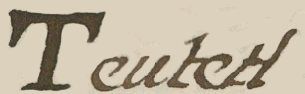
Teutetl
teotetl
Stephanie Wood
1577
Jeff Haskett-Wood
piedras negras, piedra, joya, joyas, gem, gems, gemstone
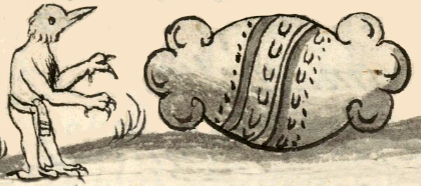
teote(tl), jet, black amber, https://nahuatl.wired-humanities.org/content/teotetl
el azabache, o el ámbar negro
Stephanie Wood
Available at Digital Florentine Codex/Códice Florentino Digital, edited by Kim N. Richter and Alicia Maria Houtrouw, "Book 11: Earthly Things", fol. 209v, Getty Research Institute, 2023. https://florentinecodex.getty.edu/en/book/11/folio/209v/images/0 Accessed 16 November 2025.
Images of the digitized Florentine Codex are made available under the following Creative Commons license: CC BY-NC-ND (Attribution-NonCommercial-NoDerivs 4.0 International). For print-publication quality photos, please contact the Biblioteca Medicea Laurenziana ([email protected]). The Library of Congress has also published this manuscript, using the images of the World Digital Library copy. “The Library of Congress is unaware of any copyright or other restrictions in the World Digital Library Collection. Absent any such restrictions, these materials are free to use and reuse.”