yaoyotl (FCbk12f1r)
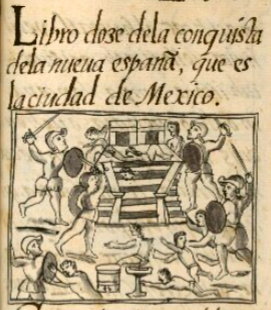
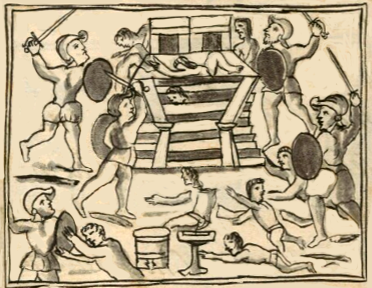
This iconographic example, featuring a black and white sketch of a battle (yaoyotl), is included in this digital collection for the purpose of making comparisons with related hieroglyphs. The term selected for this example comes from the text near the image in the Digital Florentine Codex. There is no gloss, per se. This example shows Spaniards and Mexica men fighting for control over Mexico City (symbolized by the twin temples atop a pyramid). The Spaniards have swords and shields. Heads, arms, and legs have been sliced off the Nahua combatants who were trying to defend their principal temple (templo mayor, as it is called today in Spanish). In the foreground of the battle scene are a huehuetl (a round drum that stands above knee height) and a teponaztli (a horizontal wooden drum on a pedestal), suggesting that the fighting may have begun when musicians had been drumming.
Stephanie Wood
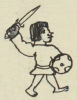
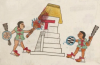
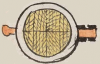
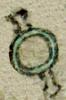
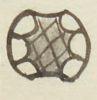
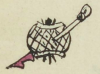
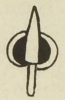
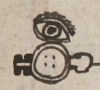
The Spanish-language text refers to this battle as part of the conquista (conquest) but the Nahuatl text simply refers to yaoyotl (battles) on this page. In another iconographic battle scene in this digital collection, two Indigenous men square off in front of a temple. The language there refers to a defeat (tepehualiztli). Nahuatl hieroglyphs for yaoyotl can be shields grouped with bows and arrows (harking back to Chichimec conflicts). Much more prevalent are hieroglyphs for enemy or combatant (yaotl), usually represented simply by a single shield, but a weapon can be visible behind or even in front of the shield, such as an arrow (mitl), an obsidian-studded club (macuahuitl), or a knife.
Stephanie Wood
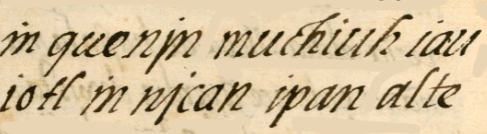
…iauiotl…
…yaoyotl…
Stephanie Wood
1577
Jeff Haskett-Wood
batallas, conflicto, conflictos, conquistas, armas, arco, arcos, flecha, flechas, cuchillo, daga, espada, espadas, amputación, pierna, piernas, brazo, brazos, templo, templos, escalera, escaleras
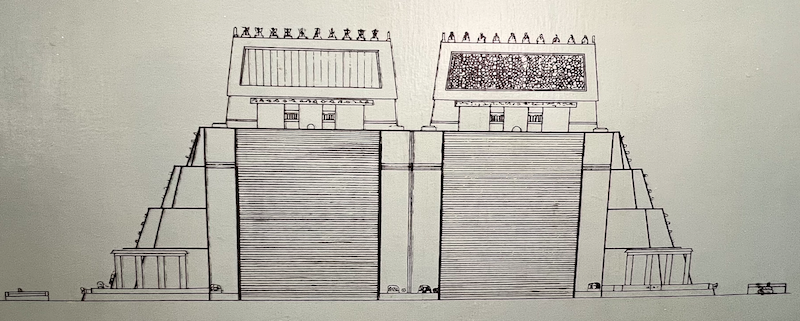
This drawing of a double or paired temple comes from the Tenayuca archaeological museum. The signage states that the Mexico City templo mayor was modeled after this earlier one. Other examples of paired temples can be found in Tlatelolco, Teopanzolco, and “Yacates,” according to the Tenayuca museum. Photograph by Stephanie Wood, 3 February 2026.
yaoyotl, battles, fighting, warfare, https://nahuatl.wired-humanities.org/content/yaoyotl
la guerra, o la batalla
Stephanie Wood
Available at Digital Florentine Codex/Códice Florentino Digital, edited by Kim N. Richter and Alicia Maria Houtrouw, "Book 12: Conquest of Mexico", fol. 1r, Getty Research Institute, 2023. https://florentinecodex.getty.edu/en/book/12/folio/1/images/0 Accessed 7 February 2026.
Images of the digitized Florentine Codex are made available under the following Creative Commons license: CC BY-NC-ND (Attribution-NonCommercial-NoDerivs 4.0 International). For print-publication quality photos, please contact the Biblioteca Medicea Laurenziana ([email protected]). The Library of Congress has also published this manuscript, using the images of the World Digital Library copy. “The Library of Congress is unaware of any copyright or other restrictions in the World Digital Library Collection. Absent any such restrictions, these materials are free to use and reuse.”