Tollantzinco (Mdz30r)
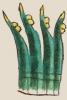
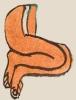
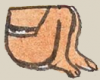
This is a green, yellow, white, and terracotta-colored painting of the compound Nahuatl hieroglyph for the place name Tollantzinco (perhaps, "Nuevo Tollan"). It features a group of four green tule reeds with small round yellow blossoms near the upper tips. The base of each reed is a small white rectangle. Coming out of the lower left corner of this group of reeds is half a man's body, terracotta-colored with the white waistband of a loincloth visible. The emphasis is on the rear end or buttocks, which brings forth the term tzintli. This is the phonetic syllable that supports the -tzinco locative suffix, which refers to new, little, lesser, or lower when put before the original version of the place name.
Stephanie Wood
Karttunen prefers to think of this place name as referring to a spin-off of Tollan (and not necessarily little).
Stephanie Wood
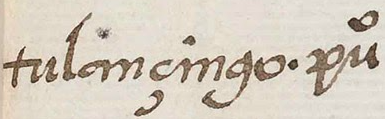
tulancingo.puo
Tollantzinco, pueblo
Stephanie Wood
c. 1541, but by 1553 at the latest
Stephanie Wood
tules, tule reeds, canes, cattails, butts, buttocks, rear end, little, lower, culos, pequeño, abajo, -tzinco locative, nalgas, trasero, Tulancingo, Tulancinco, Tolancingo, Tolancinco, Tollancingo, Tollancinco, Tullancinco, Tullancingo, Tullantzinco, nombres de lugares, fonetismo, place names
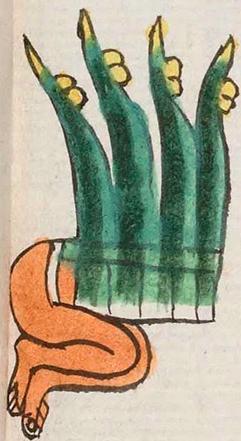
tol(lin), tule reeds, https://aztecglyphs.wired-humanities.org/content/tollin
-tzinco (locative suffix), lower, little, or new [town], https://nahuatl.wired-humanities.org/content/tzinco
Nuevo Tollan
Stephanie Wood
Codex Mendoza, folio 30 recto, https://digital.bodleian.ox.ac.uk/objects/2fea788e-2aa2-4f08-b6d9-648c00..., image 70 of 188.
The Bodleian Libraries, University of Oxford, hold the original manuscript, the MS. Arch. Selden. A. 1. This image is published here under the UK Creative Commons, “Attribution-NonCommercial-ShareAlike 3.0 License” (CC-BY-NC-SA 3.0).