macehualli micquetl (TK222v)
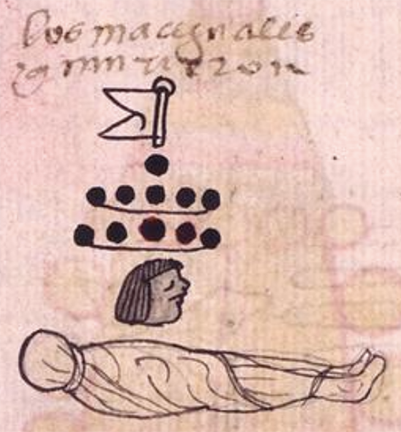
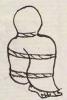
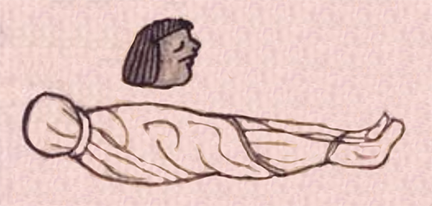
This painted compound Nahuatl hieroglyph shows a macehualli (Nahua commoner) who is now a corpse. It shows this in two ways, with the head of a man with his eyes closed and his face painted a dark gray, two indications that he is a deceased person (micqui). Below this head is a horizontal corpse (micquetl) in a shroud that is tied round the neck and legs. The gloss describes the scene as “commoners that died.” We have chosen the translation terms from our Online Nahuatl Dictionary, in the hope that they will suffice. The contextualizing image shows a notation for 220, consisting of a tecpantli flag (20) and eleven ones (multipliers). Not shown, but on the same page, the “prencipales” who have died are represented. Eight of them (who would be called pipiltin in Nahuatl) are counted in the notation, while one man sitting with a cape tied onto his shoulder, represents the group. The highest leader, the tlatoani (or tlahtoani, with the glottal stop), would surely be named if he was one of the elite community members who had died.
Stephanie Wood
The loss of 220 macehualli and eight pipiltin was surely owing to the epidemic diseases (often called cocoliztli in Nahuatl) that began to circulate through the Nahua population. with the arrival of more and more Europeans inadvertently carrying germs for which The Indigenous population had no immunities for these unfamiliar germs. The deaths are mentioned on this page of the manuscript because the colonizers were demanding goods and labor at the same time as the Indigenous population was declining, and it was extremely difficult to continue to produce the exorbitant quantities that were demanded of them. Below are some other deceased people, whether micqui or miquetl (practically synonyms).
Stephanie Wood
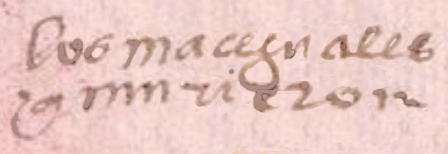
los maceguales q~ murieron
macehuales que murieron
Stephanie Wood
c. 1556
Jeff Haskett-Wood
muerte, muerto, difunto, difuntos, epidemia, epidemias, illness, illness, cocoliztli
macehual(li), commoner or Indigenous person, https://nahuatl.wired-humanities.org/content/macehualli
micque(tl), a corpse, cadaver, https://nahuatl.wired-humanities.org/content/micquetl
micqui, a deceased person, https://nahuatl.wired-humanities.org/content/micqui
los macehuales muertos
Stephanie Wood
The Codex Kingsborough, also known as the Códice de Tepetlaoztoc, and the Memorial de los indios de Tepetlaoztoc, is not on display. It was transferred from the British Library and is now held by the British Museum. It is shared on line at: https://www.britishmuseum.org/collection/object/E_Am2006-Drg-13964
©The Trustees of the British Museum. Shared under a Creative Commons Attribution-Non-Commercial-ShareAlike 4.0 International (CC BY-NC-SA 4.0) license. Please also cite the <em>Visual Lexicon of Aztec Hieroglyphsem>, ed. Stephanie Wood (Eugene, Ore.: Wired Humanities Projects, 2020-present) and this URL.