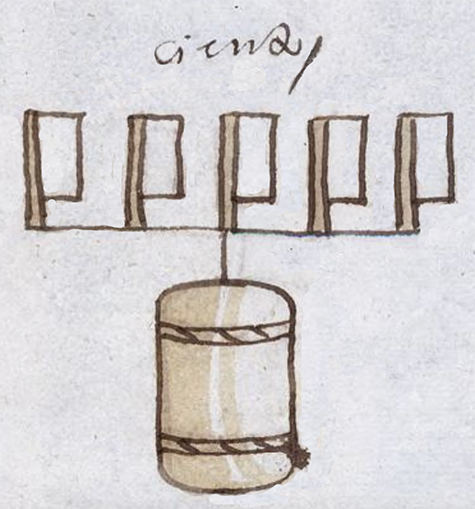
macuiltecpantli (Osu4r)
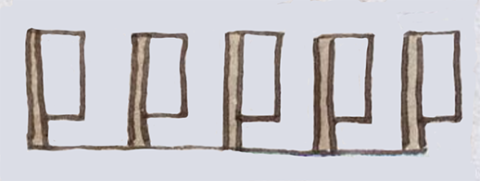
This painted simplex Nahuatl hieroglyph in notational form features five (macuilli) standing white flags (pantli or pamitl) with tan-colored wooden poles. Each flag (made of paper or fabric, it is unclear) stands for one way of expressing twenty (tecpantli), typically for things in lines or rows. Together, the five tecpantli equal 100. The contextualizing image shows–and the nearby text explains–that this number refers to 100 loads (cargas, in Spanish) of lime (tenextli, in Nahuatl, and cal, in Spanish) for use in construction. It is being paid in the form of tribute in kind to the Spanish overlord, the judge on the high court (Audiencia), who was named Doctor Villalobos. Each load is a bundle that is wrapped (probably in cloth) and tied in two places.
Stephanie Wood
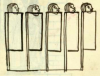
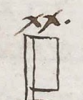
Another example of the number macuiltecpantli, from the Matrícula de Huexotzinco, appears below. That one shows the head of a laborer at the top of each flag. A labor boss (centecpanpia) would hold up a flag and twenty people would join his group (probably forming a line) in preparation for a work assignment. In this example of 100 loads of lime, the townspeople are upset that it was not paid back.
Stephanie Wood
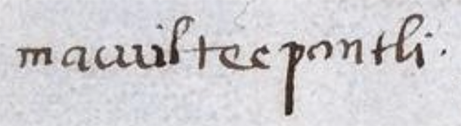
macuiltecpantli.
macuiltecpantli
Stephanie Wood
1551–1565
Jeff Haskett-Wood
tributo, tributos, número, números, cargas, cientos, cal, protesta, resistencia, colonialismo, abusos
tecpan(tli), twenty, https://nahuatl.wired-humanities.org/content/tecpantli
macuil(li), five, https://nahuatl.wired-humanities.org/content/macuilli
tenex(tli), lime (from burnt or slaked limestone), https://nahuatl.wired-humanities.org/content/tenextli
ciento
Stephanie Wood
Library of Congress Online Catalog and the World Digital Library, Osuna Codex, or Painting of the Governor, Mayors, and Rulers of Mexico, https://www.loc.gov/resource/gdcwdl.wdl_07324/. The original is located in the Biblioteca Nacional de España.
"The Library of Congress is unaware of any copyright or other restrictions in the World Digital Library Collection. Absent any such restrictions, these materials are free to use and reuse." But please cite the Biblioteca Nacional de España and this Visual Lexicon of Aztec Hieroglyphs if you use any of these images here or refer to the content on this page, providing the URL.