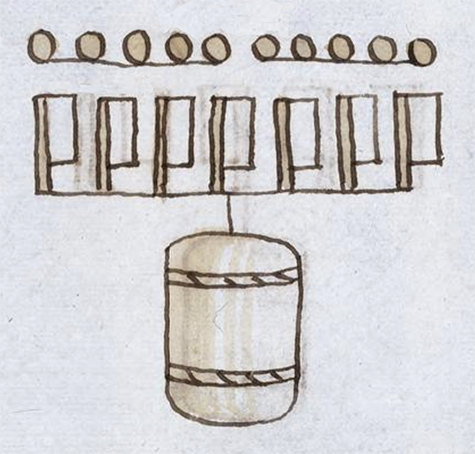
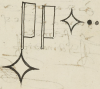
chicontecpantli ipan matlactetl (Osu4v)
This painted simplex Nahuatl hieroglyph plus a notation represents 150 (7 twenties plus 10 more) loads of tenextli (lime, in English, or cal, in Spanish) for use in construction. The twenties are represented by upright flags (tecpantli, one of the ways of saying 20, especially for things in a line or a row) with paper or textile banners in white (paper or fabric, unclear) and tan, probably wooden posts. These are all connected by a horizontal line. Above the flags are two groups of five dots, making ten. Each group of five dots (ones) are also connected by a horizontal line. The counting of ones by five is a layover from the system of counting fingers and toes to make twenty, the vigesimal base number. The loads of lime are wrapped, perhaps in cloth, and tied with cord or rope in two places. The loads were prepared for a Spanish overlord, a judge of the high court (Audiencia) named Doctor [Diego López de] Montealegre. Nothing is said on this page about being frustrated with a lack of payment for the lime. It is only noted that the Doctor had passed away.
Stephanie Wood
The term matlactetl is another way of saying matlactli. Both mean ten. The suffix -tetl (which literally means stone) is suggestive that one is counting things, and it can be attached to any number. Originally, it was for counting round or solid objects, but it gradually became unattached to shape or density and lost its meaning as a classifier.
On some of the pages in this manuscript, underlined notations can suggest multiplication, but this underlining does not indicate multiplication, and the gloss is reassuring on this point.
Stephanie Wood

chicōtecpantli ypan matlactetl.
chicontecpantli ipan matlactetl
Stephanie Wood
1551–1565
Jeff Haskett-Wood
número, números, notación, notaciones, banderas, unos, envuelto, cal, cuerda, soga, atado
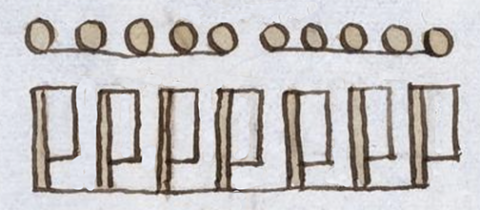
tecpan(tli), twenty, https://nahuatl.wired-humanities.org/content/tecpantli
matlac(tli), ten, https://nahuatl.wired-humanities.org/content/matlactli
tenex(tli), lime (from burnt or slaked limestone), https://nahuatl.wired-humanities.org/content/tenextli
ciento cinquenta
Stephanie Wood
Library of Congress Online Catalog and the World Digital Library, Osuna Codex, or Painting of the Governor, Mayors, and Rulers of Mexico, https://www.loc.gov/resource/gdcwdl.wdl_07324/. The original is located in the Biblioteca Nacional de España.
"The Library of Congress is unaware of any copyright or other restrictions in the World Digital Library Collection. Absent any such restrictions, these materials are free to use and reuse." But please cite the Biblioteca Nacional de España and this Visual Lexicon of Aztec Hieroglyphs if you use any of these images here or refer to the content on this page, providing the URL.