caballo (LTlaxUT1b)
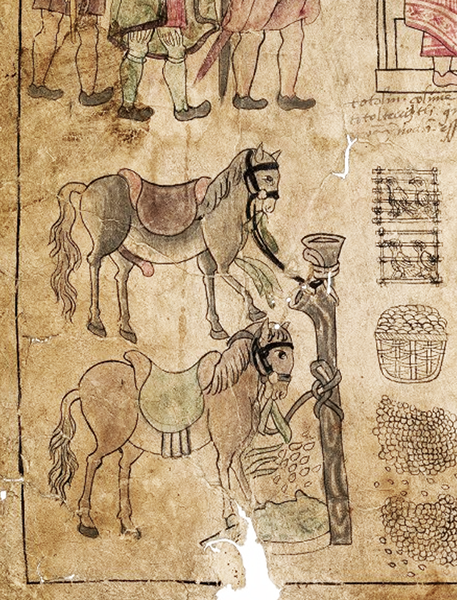
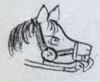
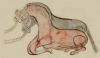
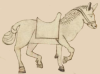
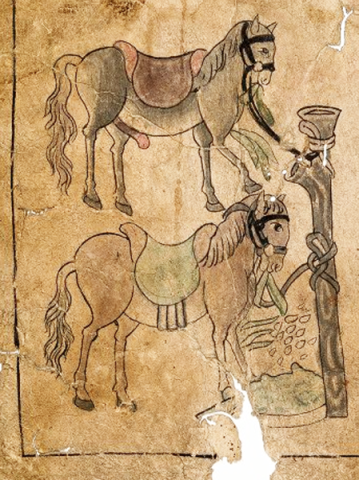
This iconographic example is included here for possible comparisons with Nahuatl hieroglyphs. It shows two horses. It is included here for the purpose of comparing the details with Nahuatl hieroglyphs. These are horses that the Spanish allies of the Tlaxcalteca were riding on the march toward Tenochtitlan. At the moment, the horses are tied to a post. They still have saddles and tackle on. The lower one has food and water on the ground in front of it. The post appears to be a former tree trunk.
Stephanie Wood
In this digital collection, horses are often in the company of Spaniards. The Spanish word for horse entered the Nahuatl language as a loanword in the sixteenth century because there was no word for horse prior to the arrival of Europeans. There had been horses in this hemisphere long ago, but they died out and were reintroduced with colonization. Nahuas at first called the horses deer (mazatl), but they fairly quickly learned the term caballo, although they would spell it in various ways. Tlacuilos would also draw and paint horses in great detail. Elite Nahuas would begin petitioning for licenses to ride horses in the sixteenth century, although there were also Nahua complaints against large animals introduced by the colonizers, because the animals were multiplying and trampling cornfields.
Stephanie Wood
1540s
Jeff Haskett-Wood
cauallo, cavallo, cabayo, cavayo, cahuayo, cauaio, cabalyo, cabalio, cahualo, cabalon, caoallo, español, españoles, aperos, sillín
caballo, horse, https://nahuatl.wired-humanities.org/content/caballo
caballo
Stephanie Wood
Benson Latin American Collection, LLILAS Benson Latin American Studies and Collections, The University of Texas at Austin https://collections.lib.utexas.edu/catalog/utblac:3c754fd0-b27f-4af7-9cf...
The Benson Library has kindly provided the digital images and permission to put them into our Mapas Project in 2015. Use and reproduction from this project: https://creativecommons.org/publicdomain/mark/1.0/, but please also cite the Visual Lexicon of Aztec Hieroglyphs, ed. Stephanie Wood, (Eugene, Ore.: Wired Humanities Projects, ©2020-present). Version 1.0.