pilli (LTlaxUT2a)
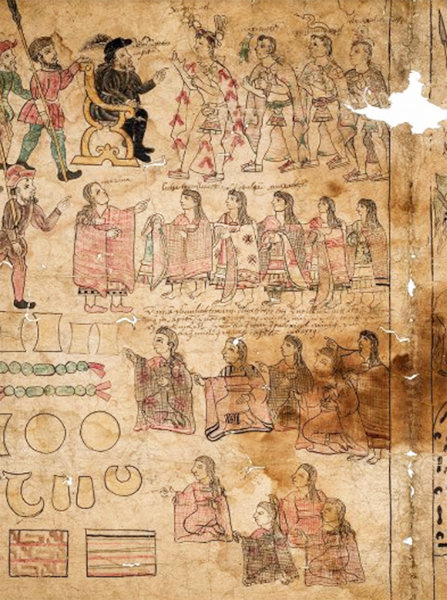
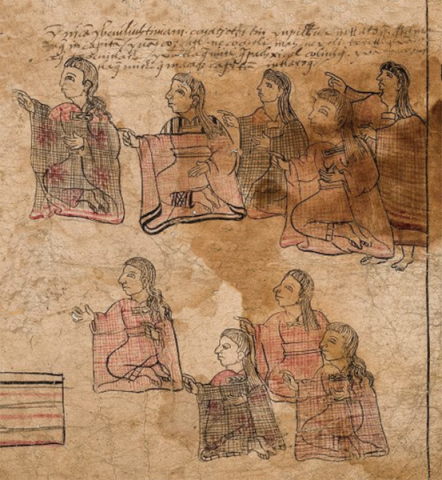
This iconographic example is included here for possible comparisons with Nahuatl hieroglyphs. It features a group of nine women, daughters of the rulers (“inpilhuan in tlatoque,” as stated in the text). They are being “given” to Hernando Cortés along with other gifts. Many of them were then baptized and “married” to men in the Spanish expedition. Another group of daughters appear above this group. They are standing while most of these women are sitting (the one on the far right is standing). The posture of sitting on one’s legs is standard for women. All the women of this group are gesturing, pointing with their index fingers. This is probably an indication that they have an association with the tlatoque (plural of tlatoani, ruler), given that the tlatoque are typically shown pointing their fingers, too, as a sign of their authority. These seated women are all wearing elaborate hand-woven multicolored blouses (huipilli). Their hair is long; it is not worn twisted upward in the neaxtlahualli style of adult women. They are shown in a ¾ view, but their heads are in a profile view, facing left.
Stephanie Wood

ynpilhuan intlatoq~
inpilhuan in tlatoque
Stephanie Wood
1540s
Jeff Haskett-Wood
jóvenes, muchachas, esposa, esposas, hija, hijas, regalo, regalos, obsequio, obsequios, noble, nobles
pil(li), child of noble lineage, https://nahuatl.wired-humanities.org/content/pilli
hijo o hija de linaje noble
Stephanie Wood
Benson Latin American Collection, LLILAS Benson Latin American Studies and Collections, The University of Texas at Austin https://collections.lib.utexas.edu/catalog/utblac:3c754fd0-b27f-4af7-9cf...
The Benson Library has kindly provided the digital images and permission to put them into our Mapas Project in 2015. Use and reproduction from this project: https://creativecommons.org/publicdomain/mark/1.0/, but please also cite the Visual Lexicon of Aztec Hieroglyphs, ed. Stephanie Wood, (Eugene, Ore.: Wired Humanities Projects, ©2020-present). Version 1.0.