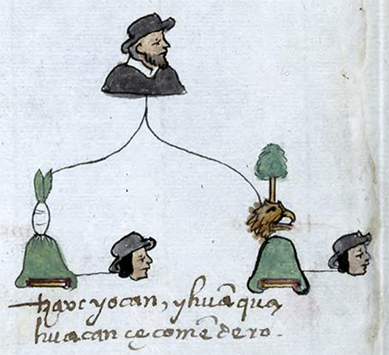
Cuauhhuacan (Osu34v)
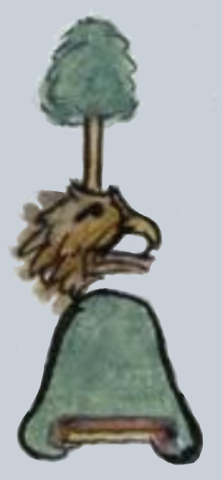
This painted compound Nahuatl hieroglyph represents the place name Cuauhhuacan ("Place Where They Have Eagles" or "Place Where They Have Trees"). There are three components. At the top is a tree (cuahuitl), a term whose stem becomes cuauh-, the same as the stem for cuauhtli (eagle). One of these two has the semantic role, and the other is a phonetic complement. Below these two elements is a green, bell-shaped hill or mountain with the horizontal red and yellow horizontal stripes at the base. The latter look much like lips. In some glyphs, water flows from this type of mouth. Together the water (atl) and hill or mountain (tepetl) could stand for altepetl (socio-political unit or ethnic state). But the sign may also simply serve as a non-specific visual locative.
Stephanie Wood
The Codex Mendoza has two other examples of this same place name, and both of them also involve eagles and trees. Really, the tree or the eagle could serve as the phonetic complement. But in one (Mendoza 5 verso) the eagle is full-sized, and the tree is small, so this might support the emphasis on the eagle in the semantic role.
Stephanie Wood
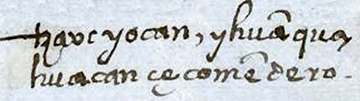
quahuacan
Cuauhhuacan
Stephanie Wood
1551–1565
Jeff Haskett-Wood
águla, árbol, árboles, cerro, cerros, montaña, montañas, nombres de lugares, topónimo, topónimos, place names
cuauh(tli), eagle, https://nahuatl.wired-humanities.org/content/cuauhtli
-hua (possessive suffix), https://nahuatl.wired-humanities.org/content/hua
-can (locative suffix), place where, https://nahuatl.wired-humanities.org/content/can-2
Donde Tienen Águilas
Stephanie Wood
Library of Congress Online Catalog and the World Digital Library, Osuna Codex, or Painting of the Governor, Mayors, and Rulers of Mexico, https://www.loc.gov/resource/gdcwdl.wdl_07324/. The original is located in the Biblioteca Nacional de España.
"The Library of Congress is unaware of any copyright or other restrictions in the World Digital Library Collection. Absent any such restrictions, these materials are free to use and reuse." But please cite the Biblioteca Nacional de España and this Visual Lexicon of Aztec Hieroglyphs if you use any of these images here or refer to the content on this page, providing the URL