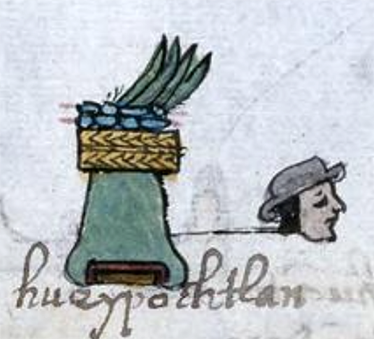
Huei Pochtlan (Osu35v)
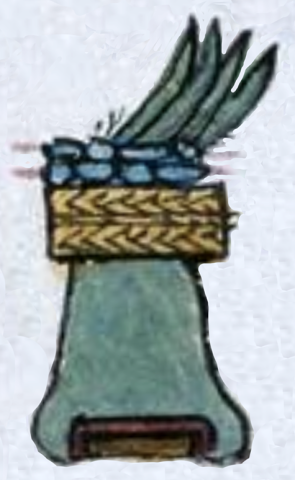
This painted compound Nahuatl hieroglyph represents Huei Pochtlan (the "Place of the Great Opochtli"), apparently referring to a divine force associated with rain and fertility, especially important for those who lived on the water, such as the lakes of central Mexico. This compound has a green bell-shaped tepetl (hill or mountain) at its base. This landscape feature could be a generic visual locative, although it does not enter into the place name. Sitting on top of the mountain or hill is what appears to be a lidded woven basket (petlacalli). On top of the basket are two strings of turquoise-blue beads and, above those, a group of what appear to be four quetzalli feathers. These could well be items of preciosity associated with the divinity of Opochtli, because they do not seem to contribute.
Stephanie Wood
The other example of a glyph for Huei Pochtlan shows a profile view of an anthropomorphic (likely male) head with yellow hair, a red face, green mouth, and a very simple feather headdress. That might be a representation of Opochtli or a priest with that association. The absence of the starting letter "O" in both of these place name glosses is puzzling. Frances Karttunen (below) explores various appearances of a morpheme -poch-. Might it have to do with youth? Might it not necessarily be a reference to Opochtli?
Stephanie Wood

hueypochtlan
Huei Pochtlan
Stephanie Wood
1551–1565
Jeff Haskett-Wood
plumas de quetzal, turquesa, turquesas, cuentas, canasta, canastas, cerro, cerros, montaña, montañas, dioses, deidades, fuerzas divinas, divinidades, nombres de lugares, topónimo, topónimos, place names
huei, great or large, https://nahuatl.wired-humanities.org/content/huei
Opochtli, a divine force associated with rain and fertility, https://nahuatl.wired-humanities.org/content/opochtli
-poch, youth (see telpochtli and ichpochtli), https://nahuatl.wired-humanities.org/content/poch
pochtlan, merchantry, https://nahuatl.wired-humanities.org/content/pochtlan
pochteca(tl), a long-distance merchant, https://nahuatl.wired-humanities.org/content/pochtecatl
-tlan (locative suffix), place, https://nahuatl.wired-humanities.org/content/tlan
-tla or -tlah (locative suffix), place of abundance of item, https://nahuatl.wired-humanities.org/content/tla-1
"Place of Great Opochtli." In her unpublished essay (shared with me) reviewing the work of Berdan and Anawalt in deciphering place names in the Codex Mendoza, Frances Karttunen apparently agrees with their translation. But she adds this in her notes: "There seems to be a morpheme in ichpo:ch- 'young woman' and telpo:ch- 'young man' that may also occur in the deity names o:po:ch- and hui:zilo:po:ch-. It forms its plural by reduplication: po:po:ch-; cf. telpo:po:chtin 'young men' rather than simply tel.po:chtin."
"Place of Great Opochtli" (Berdan and Anawalt, 1992, vol. 1, p. 188)
posiblemente, Lugar del Gran Opochtli
Stephanie Wood
Library of Congress Online Catalog and the World Digital Library, Osuna Codex, or Painting of the Governor, Mayors, and Rulers of Mexico, https://www.loc.gov/resource/gdcwdl.wdl_07324/. The original is located in the Biblioteca Nacional de España.
"The Library of Congress is unaware of any copyright or other restrictions in the World Digital Library Collection. Absent any such restrictions, these materials are free to use and reuse." But please cite the Biblioteca Nacional de España and this Visual Lexicon of Aztec Hieroglyphs if you use any of these images here or refer to the content on this page, providing the URL