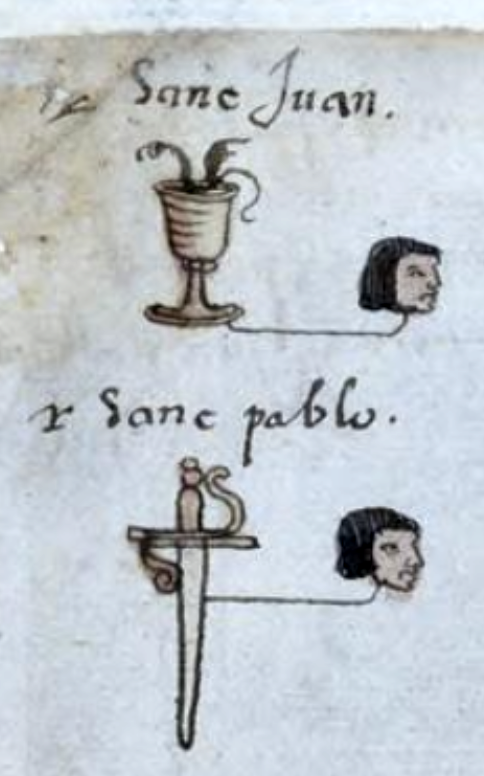
San Juan (Osu38r)
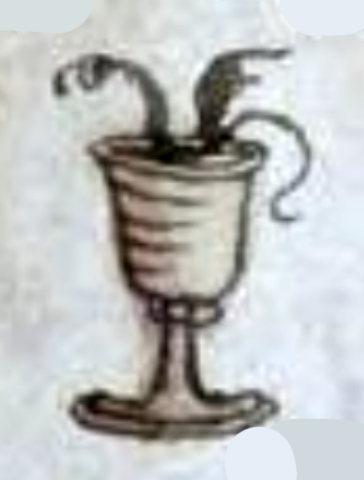
This painted simplex Nahuatl hieroglyph represents the place name San Juan (St. John, and in this case, the Baptist). The glyph borrows Christian symbolism related to this saint, which is a chalice with a snake or serpent inside it. The serpent, as shown, seems to have a wing and a curling tail. It is shown in profile, facing toward the viewer's left. The chalice has some horizontal lines that curve part way around the cup on the left-hand side, giving it a three-dimensionality.
Stephanie Wood
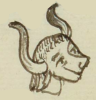
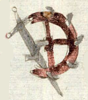
This hieroglyph, if we can call it that, borrows one hundred percent from Christian iconography. It might be considered a "loan glyph." The gloss includes a "c" at the end of San, which is an archaic or Latinate orthography. For other saints' names in this collection that have interesting iconography, see below. Many of them come from the Codex Sierra Texupa.
Stephanie Wood
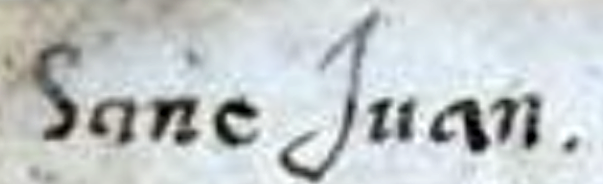
Sanc Juan.
San Juan
Stephanie Wood
1551–1565
Jeff Haskett-Wood
cáliz, cálices, santo, santos, serpiente, serpientes, snakes, nombres de lugares, topónimos, topónimo, place names
san (a loanword from Spanish), Saint, https://nahuatl.wired-humanities.org/content/san
Library of Congress Online Catalog and the World Digital Library, Osuna Codex, or Painting of the Governor, Mayors, and Rulers of Mexico, https://www.loc.gov/resource/gdcwdl.wdl_07324/. The original is located in the Biblioteca Nacional de España.
"The Library of Congress is unaware of any copyright or other restrictions in the World Digital Library Collection. Absent any such restrictions, these materials are free to use and reuse." But please cite the Biblioteca Nacional de España and this Visual Lexicon of Aztec Hieroglyphs if you use any of these images here or refer to the content on this page, providing the URL