Ahuitzotl (FCbk8f2r)
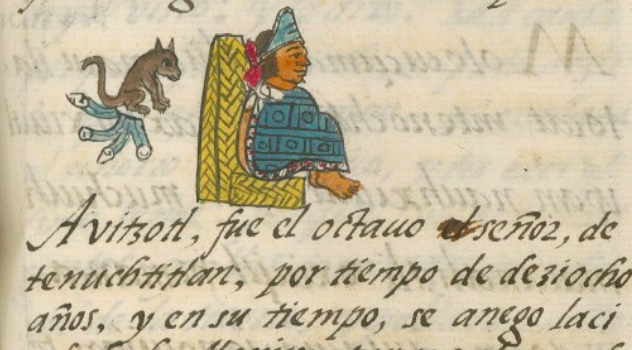
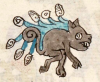
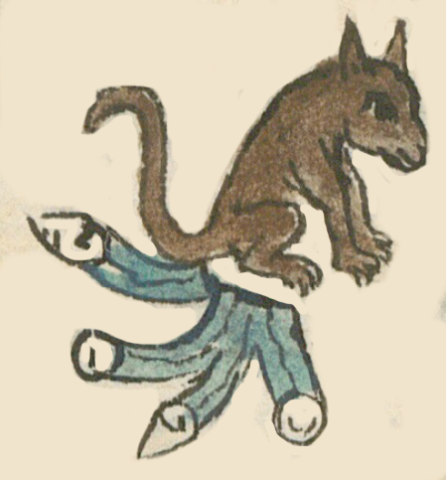
This painted compound Nahuatl hieroglyph for the personal name Ahuitzotl, a ruler of Tenochtitlan, shows a brown dog-like animal in profile, facing the viewer’s right. Its claws are visible. Its tail is up with a slight curl to it. Below the animal are four short streams of water showing lines of current and, at the lower tips, either a white droplet or a turbinate shell (alternating). The water is painted a turquoise blue.
Stephanie Wood
El jeroglífico pintado compuesto náhuatl utilizado para designar el nombre propio Ahuitzotl (uno de los gobernantes de Tenochtitlan) nos muestra un animal de color marrón parecido a un perro, de perfil y mirando hacia la derecha del espectador, con sus garras visibles y la cola erguida y ligeramente curvada. Debajo de la bestia se aprecian cuatro pequeños chorros de agua con líneas de corrientes y una gota blanca o una concha helicoidal que se alternan en los extremos de los chorros. El agua aparece de color azul turquesa.
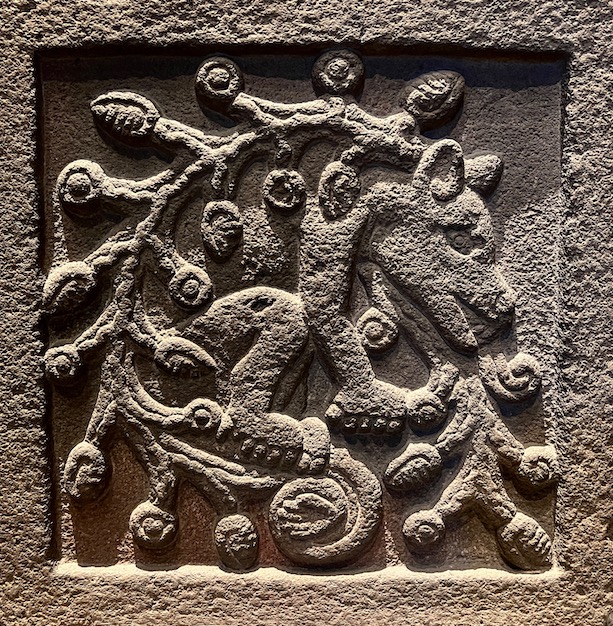
In the pre-contact carving of the Ahuitzotl glyph in the Museo Nacional de Antropología e Historia in Mexico City, water again swirls around the animal, but not specifically around the tail. Also, the tail is coiled at the bottom of the animal, and a human hand appears under the coil. It was believed that this hand, being at the end of a long tail, could reach up from under the lake waters and grab people, pulling them down and drowning them. So, the ahuitzotl was a formidable, legendary creature.
Marc Thouvenot's vignette about an image of Ahuitzotl from the Códice Matritense de la Real Academia includes a compound hieroglyph worth comparing: https://vignettes.sup-infor.com/imagen/5-RA_01_051v_b.
Stephanie Wood
En el tallado prehispánico del glifo de Ahuitzotl en el Museo Nacional de Antropología e Historia de la Ciudad de México, el agua se arremolina en torno al animal, pero no se enfoca en la cola. Además, esta se enrosca por debajo de la bestia con una mano humana en su extremo: se creía que dicha mano surgía del fondo de las aguas del lago para apoderarse de los nadadores y arrastrarlos a la muerte mediante ahogamiento. Esto hacía del ahuitzotl una criatura legendaria temible.
La viñeta de Marc Thouvenot sobre la imagen de Ahuitzotl del Códice Matritense de la Real Academia comprende un jeroglífico compuesto que vale la pena comparar: véase https://vignettes.sup-infor.com/imagen/5-RA_01_051v_b.
Avitzotl
Ahuitzotl
Stephanie Wood
1577
Jeff Haskett-Wood
animals, animales, water, agua, nombres, emperador, emperadores, tlahtoani, tlatoani, tlahtohqueh, tlatoque, tecuhtli, tecutli, teuctli, nombres famosos, personas famosas, nombres de hombres
a(tl), water, https://nahuatl.wired-humanities.org/content/atl
ahuitzo(tl), water dog, https://nahuatl.wired-humanities.org/content/ahuitzotl
huitz(tl), thorns, spines, https://nahuatl.wired-humanities.org/content/huitztli
-yo(tl), -yo(tl)-, having that characteristic or quality/inalienable possession, https://nahuatl.wired-humanities.org/content/yotl
Animal Acuático Marsupial (nombre de un emperador)
Stephanie Wood
Available at Digital Florentine Codex/Códice Florentino Digital, edited by Kim N. Richter and Alicia Maria Houtrouw, "Book 8: Kings and Lords", fol. 2r, Getty Research Institute, 2023. https://florentinecodex.getty.edu/en/book/8/folio/2r/images/0. Accessed 20 June 2025.
Images of the digitized Florentine Codex are made available under the following Creative Commons license: CC BY-NC-ND (Attribution-NonCommercial-NoDerivs 4.0 International). For print-publication quality photos, please contact the Biblioteca Medicea Laurenziana ([email protected]). The Library of Congress has also published this manuscript, using the images of the World Digital Library copy. “The Library of Congress is unaware of any copyright or other restrictions in the World Digital Library Collection. Absent any such restrictions, these materials are free to use and reuse.”