Atlauhxinqui (TK208r)
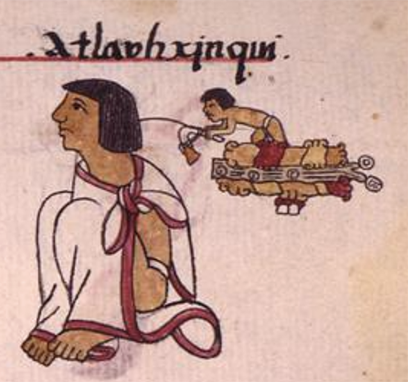
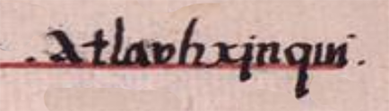
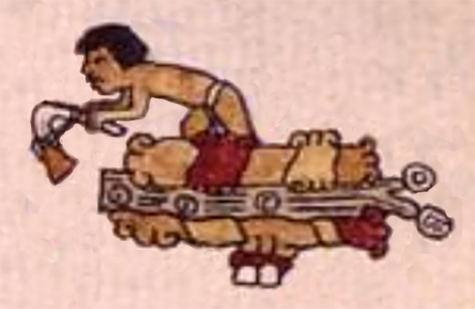
This painted compound Nahuatl hieroglyph represents the personal name Atlauhxinqui (perhaps, literally, “Ravine Woodcutter”). This is a local leader in the greater altepetl of Tepetlaoztoc in the Tetzcoco area. The compound has three or four parts. The largest feature is a raving (atlauhtli), which supplies the start to the personal name, Atlauh-. It consists of two horizontal rows of varyingly colored stones (yellow, terracotta, and red) with their curling edges. In the middle of these rows of stones runs a horizontal river with lines of current (showing motion) and three small whirlpools. At the right end of the river a droplet or bead and a turbinate shell splash off to the viewer’s right. Below the ravine, two front teeth with red upper gums appear. These teeth convey the phonetic syllable -tla-, reinforcing the middle syllable of atlauhtli. Above the ravine is a Nahua man in profile, facing left, dressed only in a loincloth, and hunched over at the waist. He is holding the curving handle of an ax that has a triangular blade tied onto the end that is away from where the man holds it. This person appears to be a woodcutter or a carpenter (xinqui). He is not in the act of sculpting or cutting anything in particular, which makes the distinction elusive. Still, the ravine association suggests woodcutting more than sculpting.
Stephanie Wood
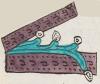
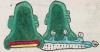
Ravines appear in this collection in a variety of designs, emphasizing various landscape features, such as agricultural land and sand (below). Thus, they are usually parts of place names rather than personal names.
Side Note: The folio numbers are not always clear in the copy published online by the British Museum. Marc Thouvenot gives this page the number K06_A in his TLACHIA digital collection, https://tlachia.iib.unam.mx/tepetlaoztoc/K06_A.
Stephanie Wood
.atlavhxinqui.
Atlauhxinqui
Stephanie Wood
c. 1556
Jeff Haskett-Wood
leña, cortar, herramienta, herramientas, cañón, agua, dientes, hombres, trabajo, trabajos, oficio, oficios, nombres de hombres, men’s names, fonetismo
atlauh(tli), deep ravine, https://nahuatl.wired-humanities.org/content/atlauhtli
xinqui, a woodcutter, carpenter, sculptor, https://nahuatl.wired-humanities.org/content/xinqui
xima, to shave or cut, https://nahuatl.wired-humanities.org/content/xima
posiblemente, Leñador de la Quebrada
Stephanie Wood
The Codex Kingsborough, also known as the Códice de Tepetlaoztoc, and the Memorial de los indios de Tepetlaoztoc, is not on display. It was transferred from the British Library and is now held by the British Museum. It is shared on line at: https://www.britishmuseum.org/collection/object/E_Am2006-Drg-13964
©The Trustees of the British Museum. Shared under a Creative Commons Attribution-Non-Commercial-ShareAlike 4.0 International (CC BY-NC-SA 4.0) license. Please also cite the <em>Visual Lexicon of Aztec Hieroglyphsem>, ed. Stephanie Wood (Eugene, Ore.: Wired Humanities Projects, 2020-present) and this URL.