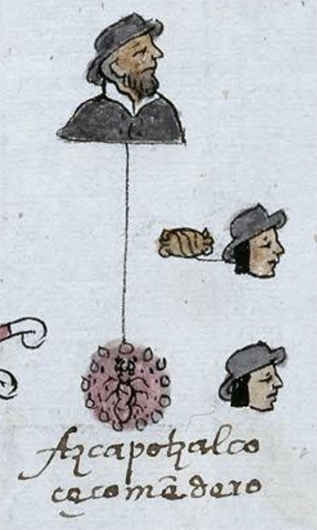
Azcapotzalco (Osu34v)
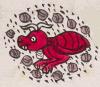
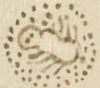
This painted compound Nahuatl hieroglyph represents the place name Azcapotzalco (perhaps "At the Ant Hill"). It shows a bird's eye view of an ant (azcatl) that has a head and a two-part body, five visible legs, and something that looks like little horns or perhaps antennae on its head. The head is at the top of what is presumably a circular mound (potzalli) that is painted grey and pink. The mound is rimmed with a circle of thirteen small round circles (presumably stones) and small black dots (presumably sand).
Stephanie Wood
The Azcapotzalco compound hieroglyph in the Codex Mendoza makes the perimeter stones into small tetl (stone) signs. In that one, the ant is shown in profile. But in the hieroglyph for the Azcapotzalca people (in the Codex Azcatitlan) the ant is shown in a bird's eye view.
Stephanie Wood
Azcapotzalco
Stephanie Wood
1551–1565
Jeff Haskett-Wood
nombres de lugares, topónimos, piedras, arena, hormiga, hormigas

azca(tl), ant, https://nahuatl.wired-humanities.org/content/azcatl
potzal(li), mound, hill), https://nahuatl.wired-humanities.org/content/potzalli
-co (locative suffix), https://nahuatl.wired-humanities.org/content/co
azcapotlzalco, a place name, https://nahuatl.wired-humanities.org/content/azcapotzalco
"En el Hormiguero"
Stephanie Wood
Library of Congress Online Catalog and the World Digital Library, Osuna Codex, or Painting of the Governor, Mayors, and Rulers of Mexico, https://www.loc.gov/resource/gdcwdl.wdl_07324/. The original is located in the Biblioteca Nacional de España.
"The Library of Congress is unaware of any copyright or other restrictions in the World Digital Library Collection. Absent any such restrictions, these materials are free to use and reuse." But please cite the Biblioteca Nacional de España and this Visual Lexicon of Aztec Hieroglyphs if you use any of these images here or refer to the content on this page, providing the URL