callan (Osu7v)
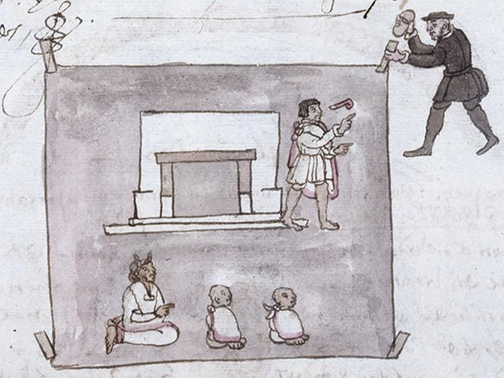
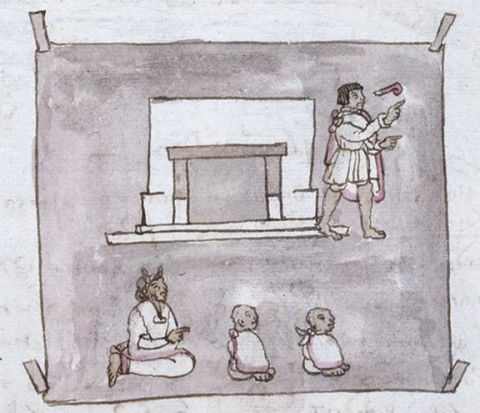
This painted iconographic example features a Nahua family on a parcel surrounding their house (callan). This square piece of land outside the house has been marked in the four corners with wooden stakes. The contextualizing image shows a Spaniard pounding the wooden stakes (“tzotzona estaca” in the nearby Nahuatl text, involving a loanword from Spanish). The Nahua man (called a “macehualtzintli” in the text) on the property is wearing a white belted tunic and a red-trimmed cape, clothing that suggests some social status. He also points with his index finger, and a colored speech scroll comes from his mouth, further indicators of his status. He is speaking to the Spaniard who is putting in the stakes. Sitting on the lower edge of the property is a woman in relatively fine clothing (with red trim). Her blouse comes to a point at the front along the bottom edge, which may be a quechquemitl. She has a long tunic underneath it. The overblouse with the point also has a rectangular reinforcement under the V-neck, much like a huipilli has. The two little boys wear red-trimmed capes like their father.
Stephanie Wood
Ironically, the Nahuatl text refers to the Spanish colonial officials who were coming to “give land” (temamaca tlalli) to the people “here in Mexico.” Of course, the land really belonged to the Nahuas from time immemorial, but the Spaniards made a great showing of “giving” them their land and officially “founding” their towns (again). It seemed like a positive gesture, and it was usually remembered in proud terms in Nahua-authored histories, but it quietly underlined how the Spanish colonial authorities had this power to decide how much to “give to” and “recognize for” whom, just when, and where.
Stephanie Wood
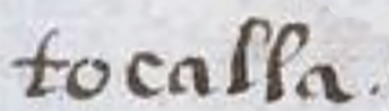
tocallan.
tocallan
Stephanie Wood
1551–1565
Jeff Haskett-Wood
mapilhuia, milli, milpa, tierras, demarcar, casa, casas, familia, niňos, mujer, arquitectura, colonialismo, espaňoles, volutas
callan, outside the house, https://nahuatl.wired-humanities.org/content/callan
cal(li), house or building, https://nahuatl.wired-humanities.org/content/calli
tlal(li), land, https://nahuatl.wired-humanities.org/content/tlalli
-tlan, near, among, https://nahuatl.wired-humanities.org/content/tlan
tzotzona, to pound, https://nahuatl.wired-humanities.org/content/tzotzona
la tierra alrededor de la casa
Stephanie Wood
Library of Congress Online Catalog and the World Digital Library, Osuna Codex, or Painting of the Governor, Mayors, and Rulers of Mexico, https://www.loc.gov/resource/gdcwdl.wdl_07324/. The original is located in the Biblioteca Nacional de España.
"The Library of Congress is unaware of any copyright or other restrictions in the World Digital Library Collection. Absent any such restrictions, these materials are free to use and reuse." But please cite the Biblioteca Nacional de España and this Visual Lexicon of Aztec Hieroglyphs if you use any of these images here or refer to the content on this page, providing the URL.