Chichiccuauhtla (Osu35r)
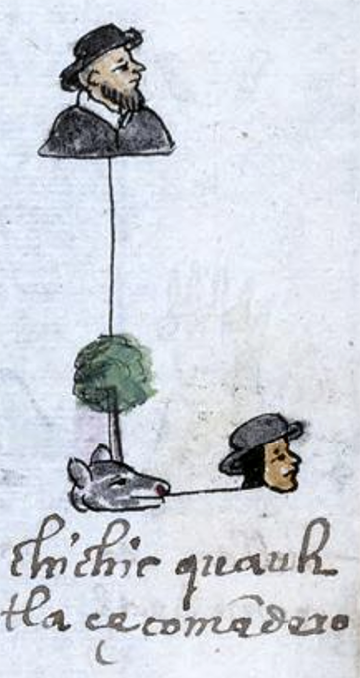
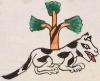
This painted compound Nahuatl hieroglyph represents the place name, Chichiccuauhtla (perhaps, "Place of Abundant Bitter Trees"). Chichiccuahuitl (sometimes spelled chichicuahuitl) trees or quinine trees are other translations. Alternately, the second of the double c's could drop and be replaced with -h-, for huauhtli (amaranth), which would result in "Place of Abundant Bitter Amaranth." If any of these translations is correct, then the dog's (chichi) head serves as a phonetic indicator for chichic (bitter). This head is a mottled gray and white, shown in profile, and facing the viewer's right. The tree has a long, thin, vertical trunk painted brown on one side and white or gray on the other, as though to show a source of light from the left. But the greenery of the tree is lighter on the right, as though the source of light is on the right. The shading suggests a three-dimensionality.
Stephanie Wood
There is a Chichicuauhtla in the municipality of Tepeyahualco, in the state of Puebla, Mexico, today. The loss of a -c- is not surprising considering the general evolution of place name orthography.
Stephanie Wood
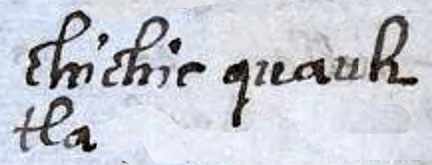
chichic quauh tla
Chichiccuauhtla
Stephanie Wood
1551–1565
Jeff Haskett-Wood
árbol, árboles, abundancia, amargo, quinina, perro, perros, nombres de lugares, topónimo, topónimos, place names

chichic, something bitter, https://nahuatl.wired-humanities.org/content/chichic
cuahui(tl), tree, https://nahuatl.wired-humanities.org/content/cuahuitl-1
huauh(tli), amaranth, https://nahuatl.wired-humanities.org/content/huauhtli
chichi, dog, https://nahuatl.wired-humanities.org/content/chichi
-tla, place of abundance of something, https://nahuatl.wired-humanities.org/content/tla-1
"Where There Are Many Chichiquauhtla Trees" (Berdan and Anawalt, 1992, vol. 1, p. 177).
Donde Hay una Abundancia de Árboles Amargos
Stephanie Wood
Library of Congress Online Catalog and the World Digital Library, Osuna Codex, or Painting of the Governor, Mayors, and Rulers of Mexico, https://www.loc.gov/resource/gdcwdl.wdl_07324/. The original is located in the Biblioteca Nacional de España.
"The Library of Congress is unaware of any copyright or other restrictions in the World Digital Library Collection. Absent any such restrictions, these materials are free to use and reuse." But please cite the Biblioteca Nacional de España and this Visual Lexicon of Aztec Hieroglyphs if you use any of these images here or refer to the content on this page, providing the URL