Chimal (Verg45v)
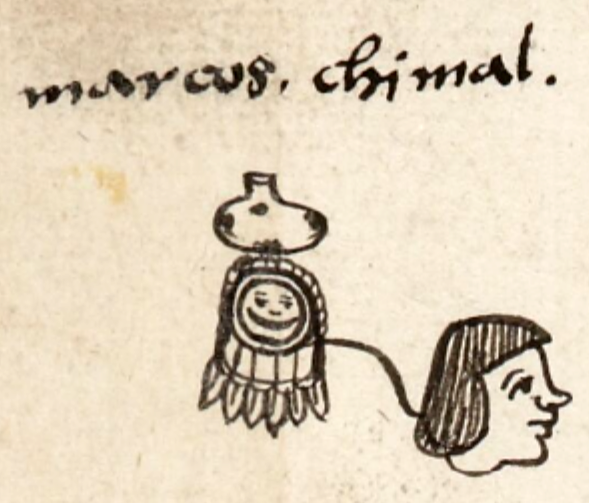
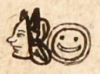
This compound Nahuatl hieroglyph is a black-line drawing of the personal name Chimal (“War Shield”), attested here as a man’s name. It has two elements, the first is a frontal view of a round war shield with two concentric circles. Apparently, long wing feathers hang down from the lower third of the outer circle. Perhaps shorter feathers decorate the upper two-thirds of the outer circle. The inner circle contains a smiling face. The eyes are European in style, and eyebrows appear above them. The nose is just a short horizontal line, The mouth is large and curved upward into a smile. Above the shield is what appears to be a container. Perhaps this vessel contains chiyantli seeds (also spelled chian in Nahuatl and chia in Spanish), as one appears to be drawn at the center of the upper part of the jug. This element seems intended to provide the phonetic syllable -chi- as a complement for the start of the name, Chi-.
Stephanie Wood
The smiling face is common on war shields as drawn in this manuscript, but it has some slight variations, and it is rare in manuscripts from other places, such as Huexotzinco or Mexico City. It may represent European influence. Perhaps the face of the sun is implied, given the use of suns as a heraldic charge in medieval and Renaissance art. See, for example, the fifteenth-century Book of Hours in France. Faces on European shields can also represent Christ or saints.
Stephanie Wood
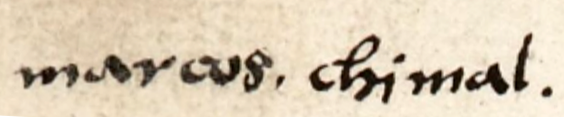
marcos. chimal.
Marcos Chimal
Stephanie Wood
1539
Jeff Haskett-Wood
escudos, semillas, chia, barro, jarra, vasija, recipiente, nombres de hombres, men’s names, fonetismo, earthenware, ceramic, ceramics, cerámicas, jug, pot, olla, jarro, vessel, vessels, vasija de cerámica, cántaro, cántaros, xoctli, xoctepi, huicolli, atlacuihuani, tecomitl, tecontontli, apilolli

chimal(li), war shield, https://nahuatl.wired-humanities.org/content/chimalli
Escudo
Stephanie Wood
Available at Codex Vergara, folio 45v, https://gallica.bnf.fr/ark:/12148/btv1b84528032/f98.item.zoom, accessed 25 March 2026. The Vergara is associated with Tepetlaoztoc, in the larger region of Tetzcoco, c. 1539–1543. “Source gallica.bnf.fr / BnF.” We would also appreciate a citation to the Visual Lexicon of Aztec Hieroglyphs, https://aztecglyphs.wired-humanities.org/.
Image Rights: The non-commercial reuse of images from the Bibliothèque nationale de France is free as long as the user is in compliance with the legislation in force and provides the citation: “Source gallica.bnf.fr / Bibliothèque nationale de France” or “Source gallica.bnf.fr / BnF.” We would also appreciate a citation to the Visual Lexicon of Aztec Hieroglyphs, https://aztecglyphs.wired-humanities.org/