chipolli (FCbk11f212v)
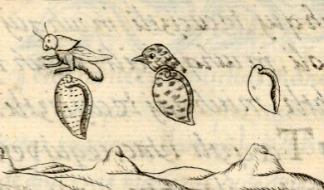
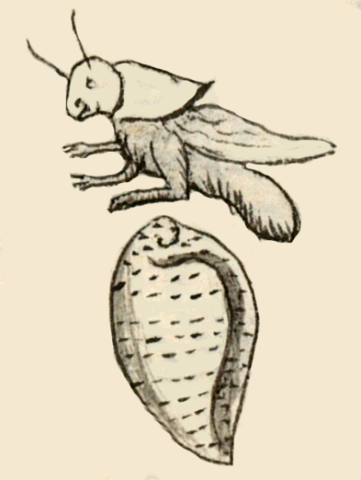
This compound Nahuatl hieroglyph features a black-line drawing of a type of gastropod shell called the chipolli (and alternatively, chipolin). The term selected for this example comes from the text near the image in the Digital Florentine Codex. There is no gloss, per se. This compound features a turbinate shell with the swirl at the top and a series of horizontal lines of dashes. The opening in the shell runs vertically along the right side, and it is shaded, giving it a three-dimensionality (a European artistic trait). A grasshopper (chapolin) hovers in the air above this shell. It is shown in profile, facing left, with its legs extended in front of it. This insect seems to serve as a phonetic indicator for the name of the shell, given that chipolli or chipolin sounds something like chapolin, a near homophone.
Stephanie Wood
The spelling of this shell name varies, with some renditions having “o” and others “u,” “l” or “ll,” and, when a single “l” ending in -in. The name, Chipol (which is represented in one of the hieroglyphs showing this shell), leaves the suffix (-li or -in) vague. The other two examples are of necklaces made from this shell. The text for this shell in the Florentine Codex, chipoli, could go either way, having lost an “l” or lost an “n.”
Stephanie Wood

Chipoli
chipolli
Stephanie Wood
1577
Jeff Haskett-Wood
conchas, caracol, caracoles, caracolito, caracolitos
tipo de concha de gasterópodo
Stephanie Wood
Available at Digital Florentine Codex/Códice Florentino Digital, edited by Kim N. Richter and Alicia Maria Houtrouw, "Book 11: Earthly Things", fol. 212v, Getty Research Institute, 2023. https://florentinecodex.getty.edu/en/book/11/folio/212v/images/0 Accessed 16 November 2025.
Images of the digitized Florentine Codex are made available under the following Creative Commons license: CC BY-NC-ND (Attribution-NonCommercial-NoDerivs 4.0 International). For print-publication quality photos, please contact the Biblioteca Medicea Laurenziana ([email protected]). The Library of Congress has also published this manuscript, using the images of the World Digital Library copy. “The Library of Congress is unaware of any copyright or other restrictions in the World Digital Library Collection. Absent any such restrictions, these materials are free to use and reuse.”