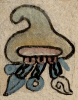
Colhuacan (TK205r)
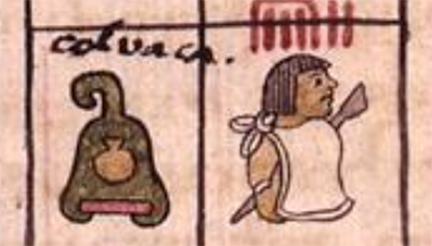
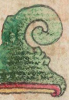
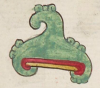
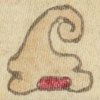
This compound Nahuatl hieroglyph represents the place name Colhuacan (perhaps, “Place With Something Bent’). This is a settlement that is part of Tepetlaoztoc (Tepetlaoxtoc in the modern spelling), Tetzcoco (Texcoco in the modern spelling), not the more famous one in the southern part of what is today Mexico City.. The compound glyph includes a green bell-shaped hill or mountain with a red horizontal line at the base and a bent peak (colli). The bell shape is like a silent locative, clarifying that this is a place. The -can locative suffix, which is not otherwise shown visually, nevertheless serves to say something like “the place where.” Finally, a ceramic pot or jug (comitl) in the middle of the bell shape is a phonetic syllable for the start of the place name, Co-.
Stephanie Wood
Colhuacan glyphs are well represented in this collection given that many codices mention the community that is now part of the capital city. The use of a comitl, however, is unusual. Nahuatl hieroglyphs in manuscripts from Tepetlaoztoc are much more phonetic than those from nearer to the capital.
Side Note: The folio numbers are not always clear in the copy published online by the British Museum. Marc Thouvenot gives this page the number K03_A in his TLACHIA digital collection, https://tlachia.iib.unam.mx/tepetlaoztoc/K03_A.
Stephanie Wood
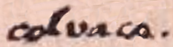
colvaca.
Colhuacan
Stephanie Wood
c. 1556
Jeff Haskett-Wood
pico, curva, cima, montaña, doblada, doblado, colores rojo verde amarillo, topónimo, topónimos, nombres de lugares, fonetismo, earthenware, ceramic, ceramics, cerámicas, jug, pot, olla, jarra, jarro, vessel, vessels, vasija de cerámica, cántaro, cántaros, xoctli, xoctepi, huicolli, atlacuihuani, tecomitl, tecontontli, apilolli
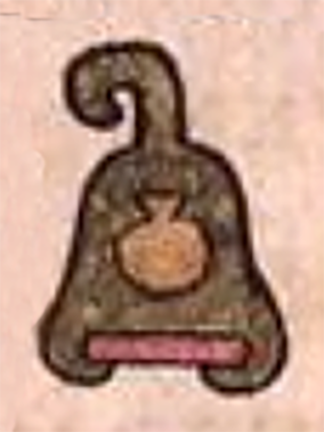
col(li), something bent, https://nahuatl.wired-humanities.org/content/colli
-hua, singular possessive, https://nahuatl.wired-humanities.org/content/hua
-can, locative suffix, where, https://nahuatl.wired-humanities.org/content/can-2
posiblemente, Donde Hay Algo Torcido
Stephanie Wood
The Codex Kingsborough, also known as the Códice de Tepetlaoztoc, and the Memorial de los indios de Tepetlaoztoc, is not on display. It was transferred from the British Library and is now held by the British Museum. It is shared on line at: https://www.britishmuseum.org/collection/object/E_Am2006-Drg-13964
©The Trustees of the British Museum. Shared under a Creative Commons Attribution-Non-Commercial-ShareAlike 4.0 International (CC BY-NC-SA 4.0) license. Please also cite the <em>Visual Lexicon of Aztec Hieroglyphsem>, ed. Stephanie Wood (Eugene, Ore.: Wired Humanities Projects, 2020-present) and this URL.