Cuateconimon (MH779r)
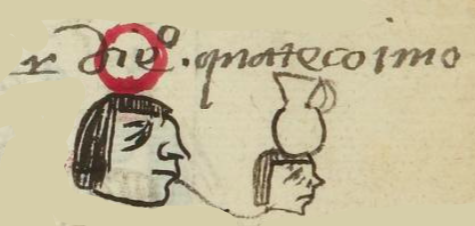
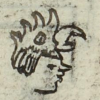
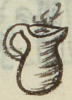
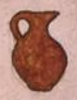
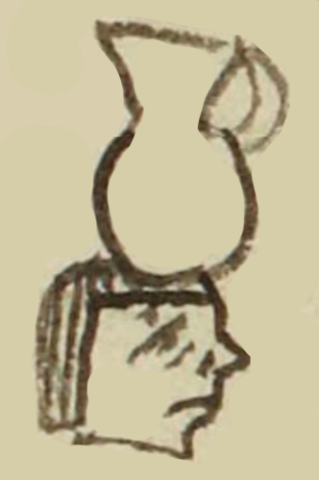
This black-line drawing of the compound glyph for the personal name Cuateconimo (perhaps “His Son-in-Law Has a Big Head”) is attested here as a man’s name. The glyph shows the head (cua-) of a man in profile, facing toward the viewer’s right. On his head is a ceramic jug or pitcher (tecomitl).
Stephanie Wood
The jug (tecomitl) seems to have a semantic value with regard to the shape of the head, but it might also be considered as a phonetic contributor, for a disyllabogram -tecon-.
While the final “n” of the name’s ending (-imon) does not appear in the gloss, It has been added here in the guess that -imon might be the intention, referring to a son-in-law (montli) (with the added possessor).
Stephanie Wood
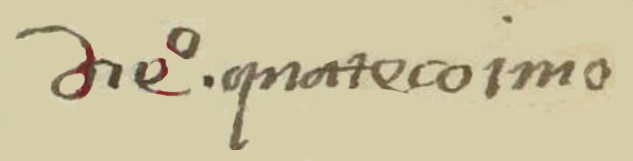
dieo quatecoimo
Diego Cuateconimon
Stephanie Wood
1560
Jeff Haskett-Wood
cerámica, jarras, cántaros, cabezas, familia, nombres de hombres, ollas, earthenware, ceramic, ceramics, cerámicas, jug, pot, olla, jarra, jarro, vessel, vessels, vasija de cerámica, cántaro, cántaros, xoctli, xoctepi, huicolli, atlacuihuani, tecomitl, tecontontli, apilolli
tecom(itl), a jug, https://nahuatl.wired-humanities.org/content/tecomitl-1
cuatecoma(tl), a large head or an aquatic fly, https://nahuatl.wired-humanities.org/content/cuatecomatl
mon(tli), son-in-law, https://nahuatl.wired-humanities.org/content/montli
-i (possessive, third person singular), his/her/its, https://nahuatl.wired-humanities.org/content/i
posiblemente, Su Yerno Tiene Una Cabeza Grande
Stephanie Wood
Matrícula de Huexotzinco, folio 779r, World Digital Library, https://www.loc.gov/resource/gdcwdl.wdl_15282/?sp=632&st=image.
This manuscript is hosted by the Library of Congress and the World Digital Library; used here with the Creative Commons, “Attribution-NonCommercial-ShareAlike 3.0 License” (CC-BY-NC-SAq 3.0).