español (TK211r)
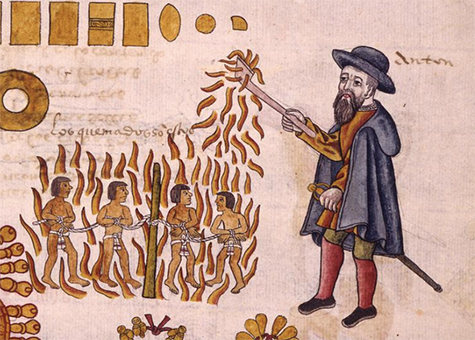
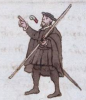
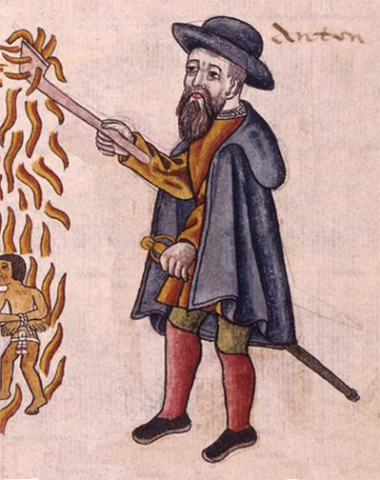
This painted iconographic example features a Spaniard (español, which was a loanword taken into Nahuatl) named Antón, who worked as a criado (servant or employee) to Hernando Cortés. He is accused in this manuscript of demanding gold and maize in huge quantities, and when he was not given these tributes rapidly, the text relates that he burned four Nahua principales (nobles). The contextualizing image shows the full scene. This man carries a sword on his body, and rests his left hand on it. In his right hand is what might be a tlemaitl, an Indigenous incense burner, to start the fire. Flames drip down toward the men who are tied up. While apparently these are Nahua nobles, the men wear only loincloths. The loincloths, however, do have horizontal red stripes, so they are more than the standard plain white. The Spaniard wears a dark gray cape and hat, a red shirt, red stockings, and black shoes. He has a full beard and mustache.
Stephanie Wood
This manuscript presents a powerful example of the way Nahuas could petition the courts against abuses by colonial Spaniards. Another important protest appears in the example of the caltechtli, below. Most Spaniards who appear in this digital collection were government officials (doctor, oidor, regidor, alcalde, etc.), interpreters, or notaries. While one might think the “conquest” loomed large in Nahua thinking in the sixteenth century, Nahua pictorials only occasionally show battles (for example, in Book 12 of the Florentine Codex) and abuses. More often, when they show Spaniards, they show daily life under colonial domination, which they regularly negotiated. The frequent riots and local uprisings described in William B. Taylor, Drinking, Homicide, and Rebellion in Colonial Mexican Villages (1979), were especially prevalent in the seventeenth and eighteenth centuries, but they do not figure as much in the codices. That said, this manuscript was produced as part of the community’s resistance in the courts to the unreasonable taxation being demanded vis-a-vis the size of the community, especially as the population was declining as a result of diseases inadvertently brought over from Europe.
Side Note: The folio numbers are not always clear in the copy published online by the British Museum. Marc Thouvenot gives this page the number K09_A in his TLACHIA digital collection, https://tlachia.iib.unam.mx/tepetlaoztoc/K09_A.
Stephanie Wood
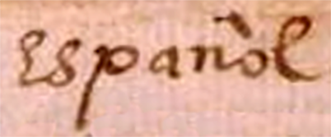
Español
Stephanie Wood
c. 1556
Jeff Haskett-Wood
fuego, quemar, hoguera, crimen, castigo, tributos, jerarquía indígena, colonialismo, abusos, resistencia
español, a Spaniard, https://nahuatl.wired-humanities.org/content/espanol
el español
Stephanie Wood
The Codex Kingsborough, also known as the Códice de Tepetlaoztoc, and the Memorial de los indios de Tepetlaoztoc, is not on display. It was transferred from the British Library and is now held by the British Museum. It is shared on line at: https://www.britishmuseum.org/collection/object/E_Am2006-Drg-13964
©The Trustees of the British Museum. Shared under a Creative Commons Attribution-Non-Commercial-ShareAlike 4.0 International (CC BY-NC-SA 4.0) license. Please also cite the <em>Visual Lexicon of Aztec Hieroglyphsem>, ed. Stephanie Wood (Eugene, Ore.: Wired Humanities Projects, 2020-present) and this URL.