español (Osu38v)
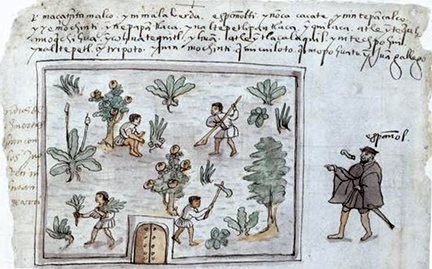
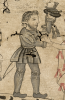
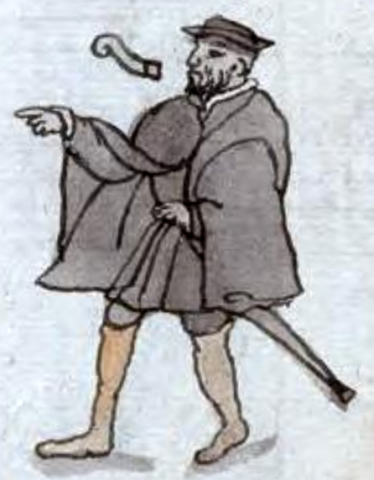
This painted example of a simplex Nahuatl hieroglyph represents a Spanish overlord who is supervising tribute labor on a parcel of land that has a wooden door as a gate and a wall around the property. The man wears tan stockings brown knee-length clothing with a cape over that and a sword sheath comes out below and behind the cape. He also has a hat on. The man gestures with his right hand, pointing with his finger. A speech scroll emerges from his mouth.
Stephanie Wood
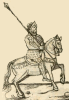
Spanish men appearing in Nahuatl manuscripts tend to be judges, cabildo members, expedition leaders, armed men, religious men, notaries, and interpreters. Spanish women are rare; a couple that appear were wives of encomenderos. In Nahuatl alphabetic texts, especially from the sixteenth century, Spaniards were often referred to as cristianos (spelled variously, including as christianos, xpianos, christianosme, quixtianotin, etc.).
Stephanie Wood
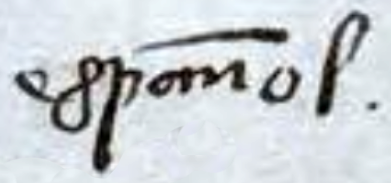
español.
español
Stephanie Wood
1551–1565
Jeff Haskett-Wood
mapilhuia, cloak, cloaks, swords, capa, capas, hats, sombreros, espada, espadas, colonialismo, trabajo, tributo
español, Spaniard, https://nahuatl.wired-humanities.org/content/español
Library of Congress Online Catalog and the World Digital Library, Osuna Codex, or Painting of the Governor, Mayors, and Rulers of Mexico, https://www.loc.gov/resource/gdcwdl.wdl_07324/. The original is located in the Biblioteca Nacional de España.
"The Library of Congress is unaware of any copyright or other restrictions in the World Digital Library Collection. Absent any such restrictions, these materials are free to use and reuse." But please cite the Biblioteca Nacional de España and this Visual Lexicon of Aztec Hieroglyphs if you use any of these images here or refer to the content on this page, providing the URL