Huitzilihuitl (TK207v)
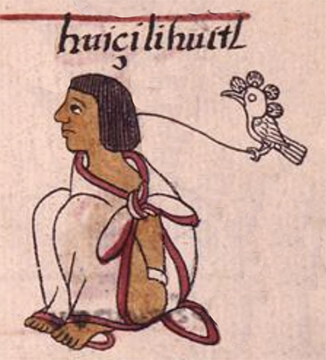
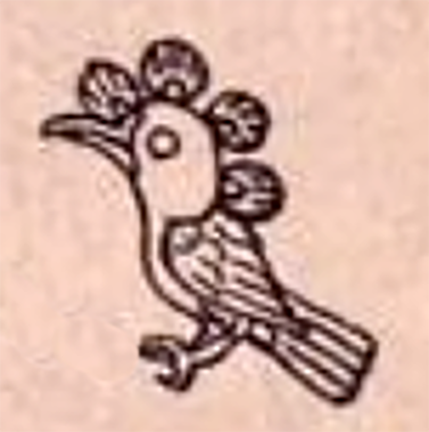
This black-line drawing of a compound Nahuatl hieroglyph represents the personal name Huitzilihuitl (“Hummingbird Feather”), a late fourteenth- and/or early fifteenth-century ruler of Tenochtitlan. This compound has two elements. One is a hummingbird almost standing, in profile, looking to the left. Its head is white, and its beak is somewhat long. Four small feathers, perhaps down feathers, ring the top of its head.
Stephanie Wood
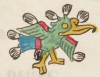
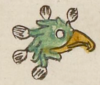
This glyph is typical in its effort to portray a hummingbird surrounded by small feathers. See some other examples below.
Side Note: The folio numbers are not always clear in the copy published online by the British Museum. Marc Thouvenot gives this page the number K05_B in his TLACHIA digital collection, https://tlachia.iib.unam.mx/tepetlaoztoc/K05_B.
Stephanie Wood
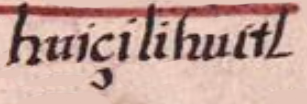
huiçilihuitl
Huitzilihuitl
Stephanie Wood
c. 1556
Jeff Haskett-Wood
plumas, colibríes, pájaro, pájaros, nombres de hombres, nombres de gobernadores, men’s names
Huitzilihuitl, a personal name, hummingbird feather; held, for example, by a ruler of Mexico-Tenochtitlan, https://nahuatl.wired-humanities.org/content/huitzilihuitl
huitzil(in), hummingbird, https://nahuatl.wired-humanities.org/content/huitzilin
ihui(tl), feather, https://nahuatl.wired-humanities.org/content/ihuitl
posiblemente, Pluma de Colibrí
Stephanie Wood
The Codex Kingsborough, also known as the Códice de Tepetlaoztoc, and the Memorial de los indios de Tepetlaoztoc, is not on display. It was transferred from the British Library and is now held by the British Museum. It is shared on line at: https://www.britishmuseum.org/collection/object/E_Am2006-Drg-13964
©The Trustees of the British Museum. Shared under a Creative Commons Attribution-Non-Commercial-ShareAlike 4.0 International (CC BY-NC-SA 4.0) license. Please also cite the <em>Visual Lexicon of Aztec Hieroglyphsem>, ed. Stephanie Wood (Eugene, Ore.: Wired Humanities Projects, 2020-present) and this URL.