Mazahuacan (TK208v)
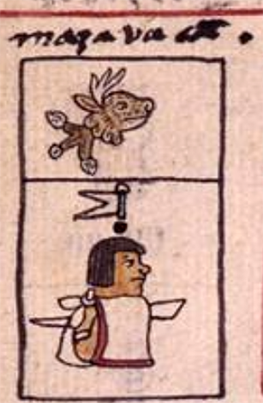
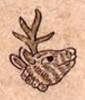
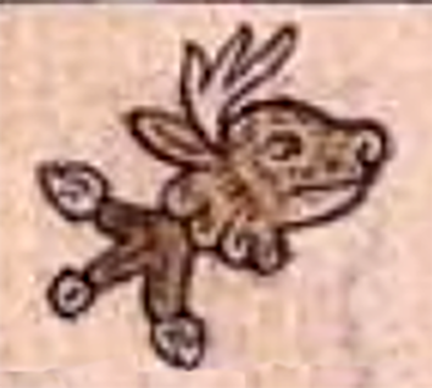
This painted compound Nahuatl hieroglyph represents the place name Mazahuacan (“Place with Deer”). It has two elements, and the reading order is right to left. On the right is the head of a deer (mazatl) in profile, facing right. Its mouth is closed, but its visible eye is open. It has a visible ear and a three-pronged antler. Its coat is mottled and colored brown. Left and slightly below the deer is a three-pronged spray of water with lines of current (movement) and two turbinate shells and one droplet or bead at the end of each short stream. The water is a somewhat darker color than the deer. It serves as a phonetic indicator of the “a” sound in this place name, but whether it refers to an -a- in Maza-, -hua-, or -can, is not clear. At least one of the -hua- and -can syllables are not shown visually. An additional feature of the deer that calls for attention is its neck, which has a scalloped edge with four rounded pieces of skin hanging down.
Stephanie Wood
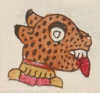
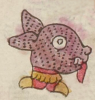
A few other animal heads in this collection have a similar edge on their necks, as though they have been severed in an uneven way. See below. All of the others come from the Codex Telleriano-Remensis. In addition to the scalloped edges on their necks, they have red and yellow coloring that may point to their interior organs or the flesh and fat that become visible inside animals and humans when they are cut into. The other Mazahuacan in this collection that comes from the Codex Tepetlaoztoc shows only a deer head, but it also has the scalloped edge to its neck.
Side Note: The folio numbers are not always clear in the copy published online by the British Museum. Marc Thouvenot gives this page the number K06_B in his TLACHIA digital collection, https://tlachia.iib.unam.mx/tepetlaoztoc/K06_B.
Stephanie Wood

mazavacā
Mazahuacan
Stephanie Wood
c. 1556
Jeff Haskett-Wood
animales, agua, nombres de lugares, topónimo, topónimos, fonetismo
maza(tl), deer, https://nahuatl.wired-humanities.org/content/hua
hua-, singular possessive, https://nahuatl.wired-humanities.org/content/hua
-can, locative suffix, where, https://nahuatl.wired-humanities.org/content/can-2
Donde Tienen Venado
Stephanie Wood
The Codex Kingsborough, also known as the Códice de Tepetlaoztoc, and the Memorial de los indios de Tepetlaoztoc, is not on display. It was transferred from the British Library and is now held by the British Museum. It is shared on line at: https://www.britishmuseum.org/collection/object/E_Am2006-Drg-13964
©The Trustees of the British Museum. Shared under a Creative Commons Attribution-Non-Commercial-ShareAlike 4.0 International (CC BY-NC-SA 4.0) license. Please also cite the <em>Visual Lexicon of Aztec Hieroglyphsem>, ed. Stephanie Wood (Eugene, Ore.: Wired Humanities Projects, 2020-present) and this URL.