Mexico (Osu34r)
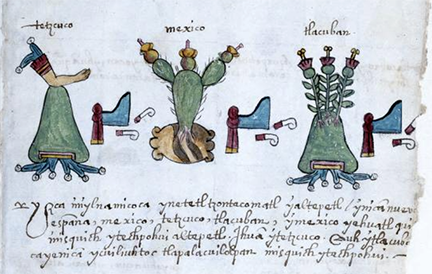
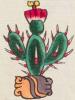
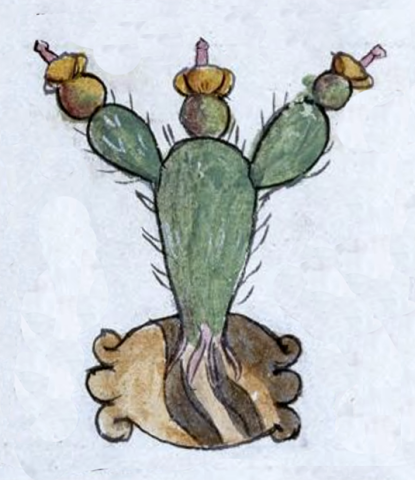
This painted compound Nahuatl hieroglyph represents the place name Mexico, although it actually reads “Tenochtitlan.” It has two elements, and the reading order is upwards. The first element, therefore, is a stone (tetl). It is tan at one end and dark brown at the other. In the middle are diagonal, curving lines that alternate in these same two colors. The ends each have three curling tidbits. Above and on the stone is a prickly pear cactus plant with long thorns, visible roots, a larger body, and two branch-like paddles (or pencas, in Spanish). At the top of each paddle and in the middle, sitting right on the main body of the plant, are the little round fruits (nochtli) that have flowers in gold and pink on the top part of the fruit.
Stephanie Wood
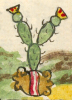
Mexico and Tenochtitlan share this emblematic hieroglyph. See, for example, the one for Tenochtitlan in the Codex Mendoza, below. The personal name glyph for the ruler Tenoch is also shared.
Stephanie Wood
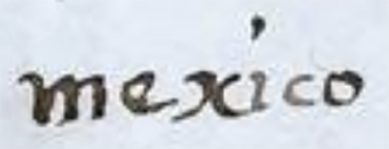
mexico
Mexico
Stephanie Wood
1551–1565
Jeff Haskett-Wood
cacto, cactos, nopal, nopales, nopalli, tuna, tunas, fruta, frutas, piedra, piedras
noch(tli), prickly pear cactus fruit, https://nahuatl.wired-humanities.org/content/nochtli
te(tl), stone, https://nahuatl.wired-humanities.org/content/tetl
Library of Congress Online Catalog and the World Digital Library, Osuna Codex, or Painting of the Governor, Mayors, and Rulers of Mexico, https://www.loc.gov/resource/gdcwdl.wdl_07324/. The original is located in the Biblioteca Nacional de España.
"The Library of Congress is unaware of any copyright or other restrictions in the World Digital Library Collection. Absent any such restrictions, these materials are free to use and reuse." But please cite the Biblioteca Nacional de España and this Visual Lexicon of Aztec Hieroglyphs if you use any of these images here or refer to the content on this page, providing the URL.