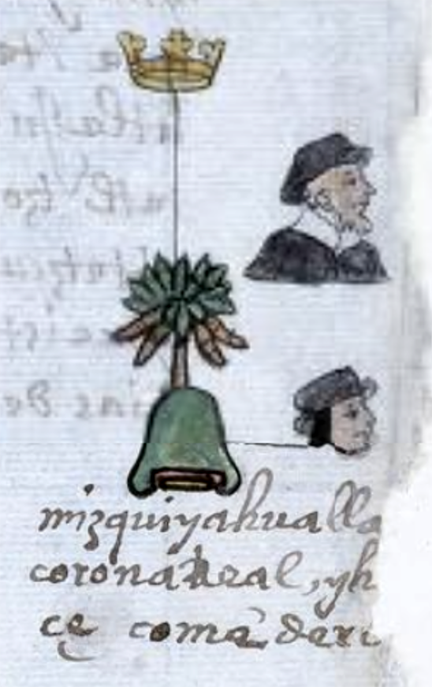
Mizquiyahuallan (Osu36r)
This painted compound Nahuatl hieroglyph represents the place name Mizquiyahuallan (perhaps "Place of the Curved Mesquite Tree"). It shows a mesquite tree on top of a hill or mountain (tepetl), which may serve here as a visual locative. Alternatively, it may tell the reader that this place is an altepetl, given that the tepetl has the red and yellow horizontal slits at the base, from which spring water (atl) will emerge in some glyphs. This mesquite tree has a straight, upright trunk and clusters of small green leaves. It also has four seed pods, two on each the right and the left side.
Stephanie Wood
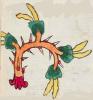
Mesquite trees are more often a bush size, but they do have the brown seed pods with edible legumes, as shown. They can be yellow pods before they turn brown, as shown in the other hieroglyph for Mizquiyahuallan in this collection (below).
The Florentine Codex includes, in its description in Nahuatl of the mezquite tree, the quote "I bend it. I form it into a circle. I make it round." This may well be at the heart of the place name represented in this compound hieroglyph. [See: the Digital Florentine Codex, Book 11, folio 124r.]The suffix could also be -tla, instead of -tlan. Either one, when attached to a stem ending in "l" will result in a doubling of the "l." The -tla refers to a place with an abundance of that material, and the -tlan refers to a place near that material. Because the final "n" can inadvertently drop away or intrude, this decision will often be a difficult one.
Stephanie Wood
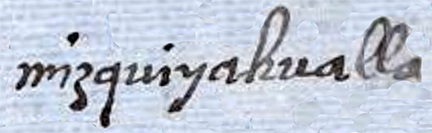
mizquiyahualla
Mizquiyahualla or Mizquiyahuallan
Stephanie Wood
1551–1565
Jeff Haskett-Wood
planta, plantas, árbol, árboles, mesquites, comida, semilla, semillas, cerro, cerros, montaña, montañas, nombres de lugares, place names, topónimo, topónimos
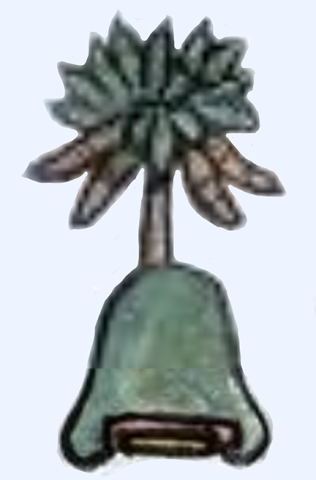
mizqui(tl), mesquite tree, https://nahuatl.wired-humanities.org/content/mizquitl
yahual(li), around or round, https://nahuatl.wired-humanities.org/content/yahualli
-tlan (locative suffix), https://nahuatl.wired-humanities.org/content/tlan
posiblemente, "Lugar del Árbol Mesquite Curvado"
Stephanie Wood
Library of Congress Online Catalog and the World Digital Library, Osuna Codex, or Painting of the Governor, Mayors, and Rulers of Mexico, https://www.loc.gov/resource/gdcwdl.wdl_07324/. The original is located in the Biblioteca Nacional de España.
"The Library of Congress is unaware of any copyright or other restrictions in the World Digital Library Collection. Absent any such restrictions, these materials are free to use and reuse." But please cite the Biblioteca Nacional de España and this Visual Lexicon of Aztec Hieroglyphs if you use any of these images here or refer to the content on this page, providing the URL