Mocuauhzoma (Verg38v)
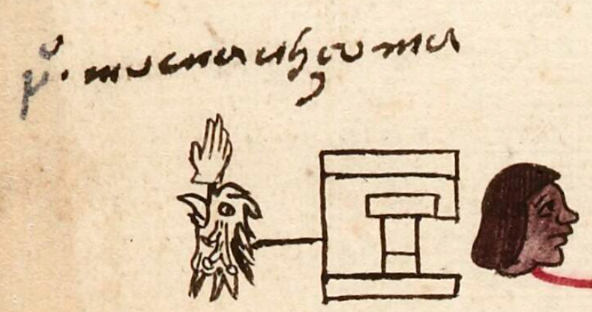
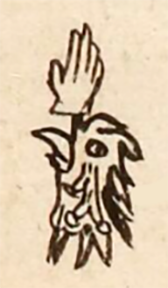
This compound Nahuatl hieroglyph is a black-line drawing of the personal name Mocuauhzoma, attested as pertaining to a man. The construction of the name is something like Motecuhzoma (reflexive+noun+verb), which here may render the meaning, “Angry Like an Eagle.” The components of the hieroglyph include, at the top, a hand (maitl), which provides the phonetic syllable for the ending of the name, -ma. Below that is the head of an eagle (cuauhtli), in profile, facing left. This is the noun in the construction, and possibly the key semantic contributor. On the neck of the eagle is a small stream of water (atl) with three short spurts, each one ending in a droplet or bead. The water provides a phonetic complement for the -ma ending to the name. What is not clear is how the Mo- start to the name and the -zo- syllable are represented. The eagle does seem to have some extra feathers on its neck which might provide some clues with further research.
Stephanie Wood
Besides the similar name Motecuhzoma, this collection also includes the name Motlahuizoma.
Stephanie Wood
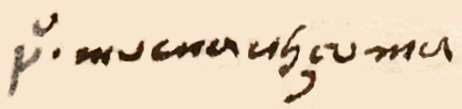
po. mocuauhçoma
Pedro Mocuauhzoma
Stephanie Wood
1539
Jeff Haskett-Wood
enojar, águilas, manos, fonetismo, nombres de hombres, men’s names
mo-, pronominal prefix of a reflexive verb, third-person singular and plural, https://nahuatl.wired-humanities.org/content/mo-1
cuauh(tli), eagle, https://nahuatl.wired-humanities.org/content/cuauhtli
zoma, to frown in anger, https://nahuatl.wired-humanities.org/content/zoma
Enojado Como un Águila
Stephanie Wood
Available at Codex Vergara, folio 38v, https://gallica.bnf.fr/ark:/12148/btv1b84528032/f84.item.zoom, accessed 1 March 2026. The Vergara is associated with Tepetlaoztoc, in the larger region of Tetzcoco, c. 1539–1543. “Source gallica.bnf.fr / BnF.” We would also appreciate a citation to the Visual Lexicon of Aztec Hieroglyphs, https://aztecglyphs.wired-humanities.org/.
Image Rights: The non-commercial reuse of images from the Bibliothèque nationale de France is free as long as the user is in compliance with the legislation in force and provides the citation: “Source gallica.bnf.fr / Bibliothèque nationale de France” or “Source gallica.bnf.fr / BnF.” We would also appreciate a citation to the Visual Lexicon of Aztec Hieroglyphs, https://aztecglyphs.wired-humanities.org/