Nauhyotl (Verg32r)
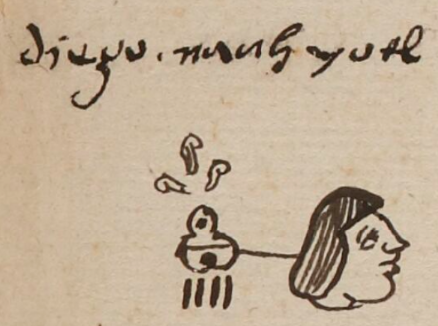
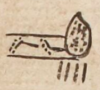
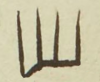
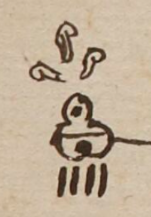
This compound Nahuatl hieroglyph is a black-line drawing of the personal name Nauhyotl (roughly translating as "Fourness," “Having the Quality of Four," or maybe "Symmetry"), attested here as a man’s name. First, it consists of four (nahui) vertical lines. Above the four lines is a bell, either an oyohualli or a coyolli, which would serve as a phonetic complement for the -yo in the name. Above the bell are three volutes, which reinforce that this is a bell, something that can make a sound. In this detail, this Nauhyotl differs from the one on folio 29 verso.
Stephanie Wood
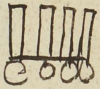
There was a Nauhyotl Tecuhtli (or Teuctli, spelled variously), the Lord of the Four Directions. So, perhaps Nauhyotl and Nauhyotzin were shorter versions of this, or perhaps they also had some connection with cardinal directions. The seventh ruler of Culhuacan had the name Nauhyotl Tecuhtlamacazqui. The simpler name Nauhyotl is further attested in at least a couple of censuses for various men after colonization. The even numbers four and eight were pervasive in Nahua culture. The suffix -yotl is, according to James Lockhart, "an abstract or collective nominal suffix that, when possessed, expresses inalienable or organic possession" (see his: Nahuatl as Written: Lessons in Older Written Nahuatl, with Copious Examples and Texts, Stanford: Stanford University Press and UCLA Latin American Studies, 2001, 242). In English, this can be something like the suffix -ness, or -ship, or refer to a design of the type mentioned in the noun. One might think of nauhyotl as referring to a quatrefoil, but the visual is very basic, seemingly relating to counting, and nothing like the four-division shield or the shape of the sun. Of course, a drawing of that sort could lead to an incorrect reading. Here, the tlacuilo wished to convey the number and its meaning. Notice how some tonalli (sun, day, solar energizing force) signs can appear as four circles (below). Guy Stresser-Péan (1995, 150) suggests "abstracción del número cuatro" as the translation of Nauhyotl. (See our Bibliography for the full citation of his book.) Magnus Pharao Hansen translates Nauhyotl as "Fourth," in his 2014 blog about the 1544 census of Morelos. Some names that are simply numbers, such as macuilli (expressed as Macuil), may have originally been names from the divinatory calendars, having had this number, one of the thirteen, in combination with one of twenty day signs. But, here, the -yotl suffix takes the number name more toward an emphasis on just the number itself and probably its symmetry. Omeyotl (duality) is another example, although it is less popular as a personal name than Nauhyotl.
Stephanie Wood

dio. nauhyotl
Diego Nauhyotl
Stephanie Wood
1539
Jeff Haskett-Wood
numbers, números, men’s names, nombres de hombres, puntos cardinales, fonetismo
nauhyo(tl), having the quality of four, https://nahuatl.wired-humanities.org/content/nauhyotl
la abstracción del número cuatro
Stephanie Wood
Available at Codex Vergara, folio 32r, https://gallica.bnf.fr/ark:/12148/btv1b84528032/f71.item.zoom, accessed 22 February 2026. The Vergara is associated with Tepetlaoztoc, in the larger region of Tetzcoco, c. 1539–1543. “Source gallica.bnf.fr / BnF.” We would also appreciate a citation to the Visual Lexicon of Aztec Hieroglyphs, https://aztecglyphs.wired-humanities.org/.
Image Rights: The non-commercial reuse of images from the Bibliothèque nationale de France is free as long as the user is in compliance with the legislation in force and provides the citation: “Source gallica.bnf.fr / Bibliothèque nationale de France” or “Source gallica.bnf.fr / BnF.” We would also appreciate a citation to the Visual Lexicon of Aztec Hieroglyphs, https://aztecglyphs.wired-humanities.org/