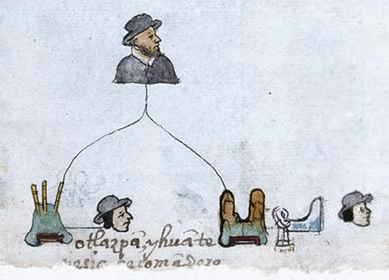
Otlazpan (Osu35r)
This painted compound Nahuatl hieroglyph represents the place name Otlazpan (perhaps "In the Canes"). The compound has two elements, starting with three yellow, segmented canes (otlatl) standing up on top of a mountain or hill (tepetl). The hill is not part of the place name, so it may serve as a visual locative, a suggestion about the local landscape. Alternatively, it may indicate that this is an altepetl (socio-political unit or ethnic state) given the presence of the red and yellow horizontal slit at the base of the mountain (tepetl) where spring water (atl) sometimes emerges.
Stephanie Wood
The Codex Mendoza (below) has a simplex hieroglyph for this place name. It consists of three yellow, segmented canes and nothing more. Another example of otlatl as part of a place name, perhaps the same one as this, can be found on the Códice de Otlazpan, a neighbor of Tepejí del Río. It appears at the top of folio 11, and it has six stalks of bamboo. Another difference is that the plant's roots show in that example (published online by Arqueología Mexicana). Frances Karttunen suggests that the "otla-" might be followed by -īxpan, which combines ix- (face, eye) with -pan, the locative suffix ("on" or "at"), to create the larger locative suffix -ixpan, "before" or "in front of," which leads to the reading she suggests as an alternative to "On the Bamboo." But, she adds, dropping the long vowel is problematical. So, I wonder if the verb "otlaza" ("to block the road") might be the root, even if the bamboo is there to provide a phonetic indicator?
Stephanie Wood
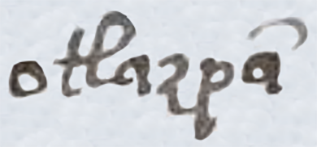
otlazpā
Otlazpan
Stephanie Wood
1551–1565
Jeff Haskett-Wood
canes, carrizo, cañas, nombres de lugares, place names, topónimo, topónimos
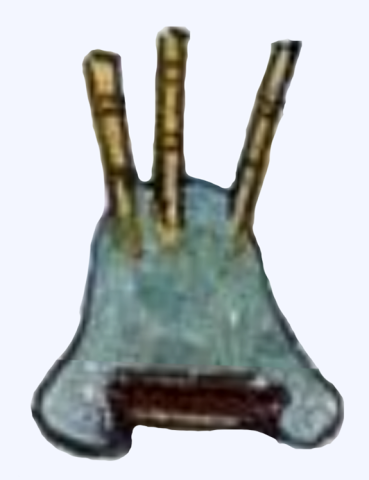
otla(tl), solid canes, bamboo-like canes, https://nahuatl.wired-humanities.org/content/otlatl
-pan (locative suffix), in or on, https://nahuatl.wired-humanities.org/content/pan
posiblemente, "En el Carrizo"
Stephanie Wood
Library of Congress Online Catalog and the World Digital Library, Osuna Codex, or Painting of the Governor, Mayors, and Rulers of Mexico, https://www.loc.gov/resource/gdcwdl.wdl_07324/. The original is located in the Biblioteca Nacional de España.
"The Library of Congress is unaware of any copyright or other restrictions in the World Digital Library Collection. Absent any such restrictions, these materials are free to use and reuse." But please cite the Biblioteca Nacional de España and this Visual Lexicon of Aztec Hieroglyphs if you use any of these images here or refer to the content on this page, providing the URL