Papalotla (TK204r)
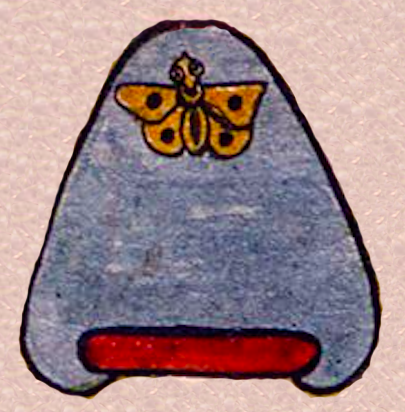
This painted compound Nahuatl hieroglyph shows the district of Papalotla (“Place of Many Butterflies”), a part of the altepetl of Tepetlaoztoc (spelled Tepetlaoxtoc today), near modern Tetzcoco (spelled Texcoco today). It shows a hill (tepetl), serving as a silent locative (-tla, where there is abundance) and an indicator that this is a settlement. The hill is a bell shape that is painted blue. It has a horizontal red stripe at the bottom, which would be the site where a natural spring might emerge. Toward the top of this blue hill is a yellow butterfly with wings spread open in a bird’s eye view. Each of the four wing parts have a black dot in the middle. The butterfly’s body has two parts, the larger part with a long black mark. Also visible is a head that comes to a point at the end toward the body. Two eyes are clearly visible on the head, showing in a frontal view.
Stephanie Wood
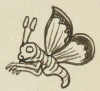
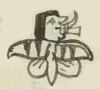
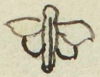
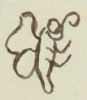
This place name does not have a gloss; the identification of the hieroglyph is supported by the work of Benjamin Johnson, Pueblos within Pueblos (2018, 55). Other examples of butterflies appear below.
Stephanie Wood
c. 1556
Jeff Haskett-Wood
mariposa, insecto, alas, colores, azul, rojo, verde, amarillo, nombres de lugares, topónimo, topónimos
papalo(tl), butterfly, https://nahuatl.wired-humanities.org/content/papalotl
-tla, a place of abundance of the preceding thing, https://nahuatl.wired-humanities.org/content/tla-1
Lugar de Muchas Mariposas
Stephanie Wood
The Codex Kingsborough, also known as the Códice de Tepetlaoztoc, and the Memorial de los indios de Tepetlaoztoc, is not on display. It was transferred from the British Library and is now held by the British Museum. It is shared on line at: https://www.britishmuseum.org/collection/object/E_Am2006-Drg-13964
©The Trustees of the British Museum. Shared under a Creative Commons Attribution-Non-Commercial-ShareAlike 4.0 International (CC BY-NC-SA 4.0) license. Please also cite the <em>Visual Lexicon of Aztec Hieroglyphsem>, ed. Stephanie Wood (Eugene, Ore.: Wired Humanities Projects, 2020-present) and this URL.