puerta (FCbk12f27v)
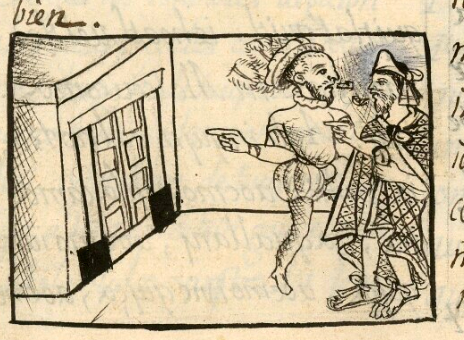
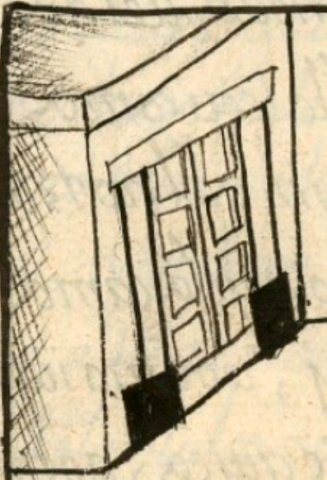
This iconographic example, featuring a black and white sketch of a building with a wooden European door (puerta, a loanword from Spanish), is included in this digital collection for the purpose of making comparisons with related hieroglyphs. The term selected for this example comes from our Online Nahuatl Dictionary. There is no relevant text or gloss, per se. This example shows a wooden door with eight inset panels. The contextualizing image shows Motecuzoma and Cortés having a conversation outside the building with the door. Note the very different clothing, footwear, and head gear for each of these very different ethnicities. This scene has three-dimensional shading, showing European artistic influence.
Stephanie Wood
This door stands out as unusual. Nothing like this probably existed at the time of early contact between Nahuas and Europeans. The tlacuilo, drawing in the second half of the sixteenth century apparently does not realize that a door of this sort–very European–would be unlikely in this time and place, unless the Spaniards quickly had one built for their own privacy, having taken over the building. Another such door appears on folio 29 recto. In early Nahua buildings, entryways were typically simply open. See an example below. For another European-type door, see Cuazaolcalzol (MH648r).
Juan José Batalla discusses the wooden door as a European architectural introduction. He shows examples from the Matrícula de Huexotzinco (1560). [See: "Análisis de elementos gráficos de contenido occidental en los glifos de los códices coloniales del Centro de México: el caso de los antropónimos nahuas," in El arte de escribir. El Centro de México: del Posclásico al siglo XVII, eds. Juan José Batalla Rosado and Miguel Ángel Ruz Barrio (Zinacantepec, Estado de México: El Colegio Mexiquense, A. C., 2018), 83.] So, the European door was familiar to the artists and authors of the period when the Florentine Codex was created, although unlikely at the time of contact.
Stephanie Wood
1577
Jeff Haskett-Wood
volutas, puertas
puerta, door, https://nahuatl.wired-humanities.org/content/puerta
la puerta de madera
Stephanie Wood
Available at Digital Florentine Codex/Códice Florentino Digital, edited by Kim N. Richter and Alicia Maria Houtrouw, "Book 12: Conquest of Mexico", fol. 27v, Getty Research Institute, 2023. https://florentinecodex.getty.edu/en/book/12/folio/27v/images/0 Accessed 7 February 2026.
Images of the digitized Florentine Codex are made available under the following Creative Commons license: CC BY-NC-ND (Attribution-NonCommercial-NoDerivs 4.0 International). For print-publication quality photos, please contact the Biblioteca Medicea Laurenziana ([email protected]). The Library of Congress has also published this manuscript, using the images of the World Digital Library copy. “The Library of Congress is unaware of any copyright or other restrictions in the World Digital Library Collection. Absent any such restrictions, these materials are free to use and reuse.”